- Startup Spells 🪄
- Posts
- 12 Velvet Rope Marketing Examples (From 1893 to a 450K Waitlist)
12 Velvet Rope Marketing Examples (From 1893 to a 450K Waitlist)
PLUS: Offline Outbound

Startup Spells 🪄
March 14, 2026
Velvet Rope is a marketing strategy that uses deliberate restriction on who can buy, join, or access what you sell. The term was coined by Rajesh Jain, who developed it as a system for identifying and nurturing a brand's most valuable customers.
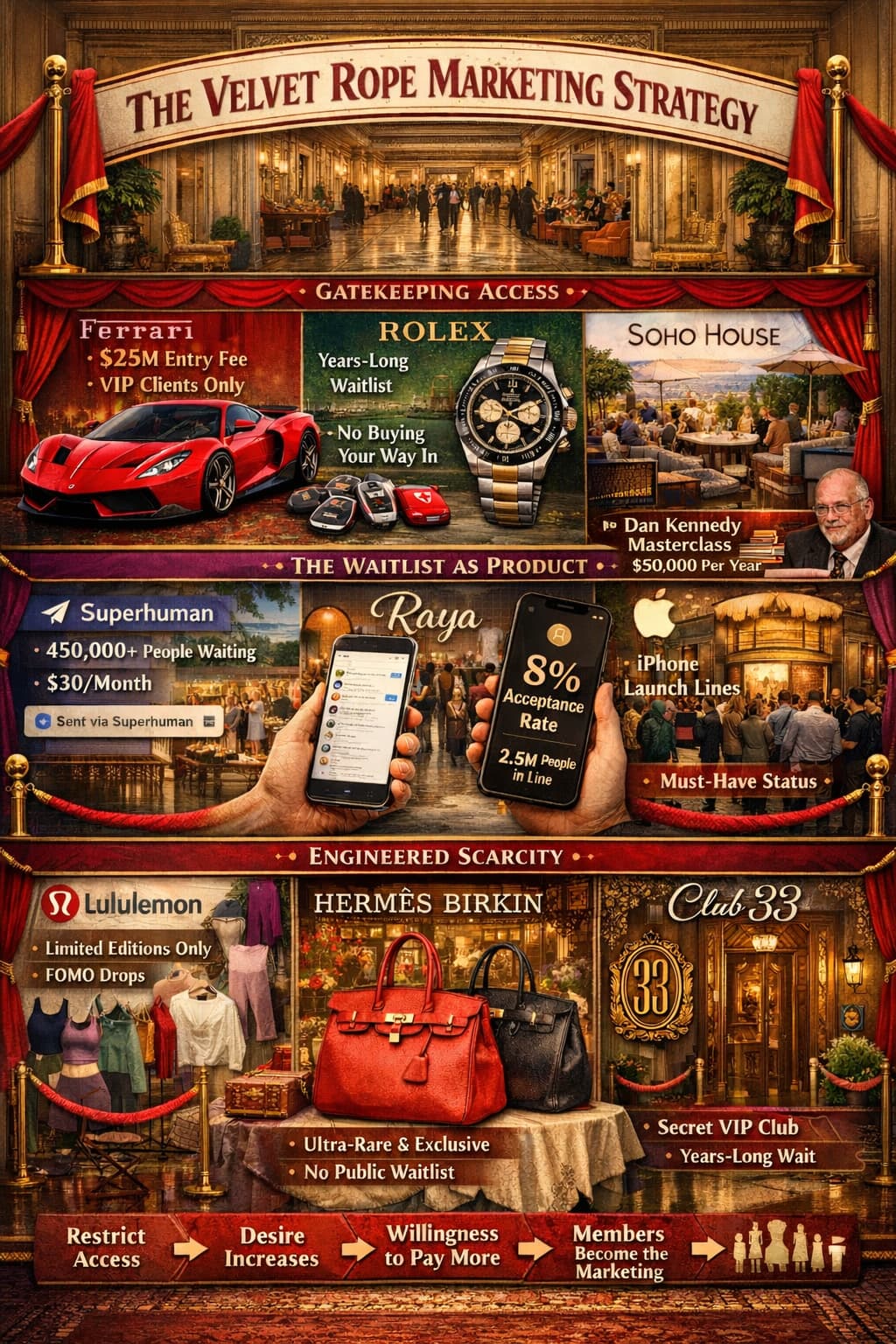
Velvet Rope Marketing Examples
It works because human psychology is wired to want what it can't have. When access is limited, 3 emotional triggers fire simultaneously. People fear missing out. People crave the bragging rights of owning something rare. And people want others to see them as part of an elite group. It's pure herd mentality.
Think of a crowded bar with a line out the door on a Saturday night. The bar across the street might pour the same drinks, but nobody's standing outside it. The line IS the review that the bar is high-end.
The math supports the instinct. A small segment of high-value customers consistently generates revenue that's wildly disproportionate to their size.
Global consumers now spend around $1.6 trillion every year on luxury goods and experiences, according to the 2024 Bain & Company and Altagamma luxury market study, underscoring how powerful the human appetite for status and indulgence remains.
Every velvet rope business makes the same conscious trade: a smaller audience in exchange for higher prices, stronger loyalty, and customers who market the product just by using it.
12 companies have mastered this trade.
The Waldorf Hotel: Where the Velvet Rope Was Invented (1893)
Before any of these patterns had a name, there was the Waldorf.
William Waldorf Astor opened a 450-room hotel on the site of his former Fifth Avenue mansion in 1893. He wasn't building a place for travelers to sleep. He was building a stage for New York's wealthiest families.
George C. Boldt, the general manager, understood this from the start. He furnished every room with European antiques. He installed electricity and private bathrooms (a first at the time). He introduced room service. Fresh flowers and a daily newspaper appeared in every room. His overarching rule for staff: the guest is always right.
He gave his employees 1 specific directive before the hotel opened: "Never speak abruptly to a woman guest nor be indifferent to her complaints." His reasoning was blunt. A woman's attitude in a hotel is based on 2 assumptions: that she is there to have things done for her without any trouble to herself, and that she can leave when she wants to, on 5 minutes' notice.
Oscar Tschirky, the maître d', memorized the names of New York's 1,368 millionaires before his first day. In an anonymous, rapidly growing city, being recognized was the rarest luxury of all. He was the original version of how Chewy wows its customers: giving personal attention to customers at a scale nobody else attempted.
The opening night set the template. George organized a charity gala for Mrs. William Kissam Vanderbilt's chosen charity. Despite heavy rain, 1500 people from the 400 most prominent families in New York showed up. Crowds lined the streets outside just to watch the guests arrive.
The Waldorf generated $4.5 million in its first year. That's over $100 million in today's dollars.
Every velvet rope company since has been running a version of George's playbook: make the inside irresistible, and let the line outside do the selling.
Velvet rope falls into 3 distinct patterns.
The Gatekeepers: Ferrari, Rolex, and the Art of Saying No
The first pattern is the most direct. You decide who gets in. Not the market. Not demand. You.
Companies that gatekeep access don't just set a high price. They set qualification criteria that money alone can't satisfy. The message is unmistakable: we choose you. You don't choose us.
Ferrari: The $25 Million Entry Fee
Ferrari doesn't sell hypercars. Ferrari grants permission to buy them.
Standard models? Visit a dealer, configure, wait. But for the LaFerrari or the F80, money is irrelevant. Ferrari headquarters decides who receives an allocation.
The LaFerrari required at least 5 prior Ferraris purchased new. The F80 reportedly requires 12-13, including 5-7 limited editions. Owners must service at official dealerships, avoid quick resales (there's an 18-month no-sell rule on certain models), participate in brand events like the Ferrari Challenge racing series and the Cavalcade rally, and customize through the Tailor Made and Atelier programs.
Ferrari segments clients into 3 tiers: important, VIP, and top. Only top-tier clients access the rarest cars. VIP status for the F80 reportedly requires $25-40 million in lifetime Ferrari spending.
2/3rds of all new Ferraris delivered in 2022 went to existing clients. Operating margins approach 30%, nearly unheard of in the auto industry. The more restrictive the rope gets, the more profitable the company becomes.
Rolex: The Waitlist You Can't Buy Your Way Off
Walk into a Rolex authorized dealer with $10,000 cash, point at a Submariner in the catalog, and the answer is the same everywhere: nothing available.
Rolex doesn't run a waitlist. It operates what dealers call an interest list, and being on it means nothing without a relationship. Rolex enforces a 70/30 rule with dealers. Roughly 70% of allocated inventory must be less desirable models. Only 30% are the steel sports watches everyone actually wants. Dealers have to move the entire catalog before they receive the pieces customers line up for.
Daytona wait times: 2-9 years. The grey market proves the strategy works. A steel Daytona regularly sells for 86% above retail. Rolex could produce more watches. It chooses not to. The scarcity is the brand.
Soho House: The Creative-Only Velvet Rope
Nick Jones founded Soho House in London in 1995 with a counterintuitive filter: not how much money you have, but what you create.
Filmmakers, designers, musicians, media professionals: in. Bankers, lawyers, corporate executives: explicitly out. In 2010, Soho House purged roughly 500 corporate members from its Manhattan location to preserve the creative atmosphere. The dress code includes not a suit policy.
Applicants detail their creative pursuits and secure endorsements from existing members. A committee of current members reviews every application. The club now operates 40+ locations across 17 countries with tiered membership: Every House (global access), Local House (single location), Under-27 (reduced pricing), and Soho Friends (travel benefits without full club access).
By 2024, Soho House generated $1.2 billion in annual revenue. Membership revenues grew 17.2% to $418 million. In Q2 2025, it posted its first quarterly net profit since going public, $24.9 million. In August 2025, the company announced a $2.7 billion deal to go private.
Disney Club 33: The Secret Inside the Theme Park
Walt Disney conceived Club 33 as a private space inside Disneyland for corporate sponsors and personal guests. He died 5 months before it opened in May 1967.
Located at 33 Royal Street in New Orleans Square, Club 33 was the only place in Disneyland that served alcohol for decades. The entrance is an unassuming green door with a small 33 plaque. Most of the park's millions of annual visitors walk past it without knowing it exists.
Membership is invite-only. Initiation fees range from $30,000-$100,000. Annual dues run $15,000-$30,000. The waitlist has historically been 10-18 years, with roughly 480 slots at Disneyland.
Disney doesn't disclose Club 33 revenue. The real value is what it gives the brand: mystique.
Dan Kennedy: The Consultant Who Fires Clients
Dan Kennedy built the Glazer-Kennedy Insider's Circle (now Magnetic Marketing) into a direct-response marketing empire. His personal consulting practice ran on a different model: he made it nearly impossible to hire him.
His Platinum Inner Circle mastermind capped membership at 15. Annual fee: $7,200. A higher tier, the Gems Gold Dozen, cost $60,000 per year. His consulting day rate hit $19,000. Fame made every number stick.
The money wasn't the real barrier. Dan actively disqualified prospects. He once returned an $80,000 retainer to a client he fired, saying the pain of the refund was less than the pain of a bad client relationship.
He called ideal clients whales. High-spending, high-implementing business owners who generated outsized returns. Dan proved that a personal brand could operate like a nightclub: the harder you are to access, the more people want in.
Superhuman, Raya, Apple, Hampton: 4 Waitlists, 1 Strategy
The second pattern turns waiting itself into a feature. The line doesn't just build demand. It becomes the primary marketing engine.
Superhuman: The 450,000-Person Waitlist for Email
Rahul Vohra charged $30/month for an email client in a market where Gmail is free. And 450,000 people lined up for the privilege.
Superhuman launched invite-only and screened every applicant with surveys about their email habits. If your volume was too low, you were denied. The product was built for power-emailers who spent 3+ hours daily in their inbox.
Every approved user was required to complete a mandatory 30-minute onboarding call. Like a personal tailor who measures you before you're allowed to buy a suit. The fitting takes 30 minutes. But every time you wear it, you remember why you waited.
At peak, 20 full-time staff handled nothing but these calls. During each session, a specialist migrated the user's email, demonstrated keyboard shortcuts, and ensured they immediately felt the speed difference. The estimated return per onboarding call: 60x customer lifetime value.
Every outgoing email carried a Sent via Superhuman line at the bottom. A status badge that doubled as a viral loop. Users referred an average of 3.4 people within 6 months.
By August 2021, Superhuman had 15,000 paying customers and an $825 million valuation. A velvet rope made people pay $360/year for something they could get for free.
Raya: The 8% Acceptance Rate Dating App
Raya launched in February 2015 as a dating app for people who would never use a dating app. Daniel Gendelman built it for celebrities, creatives, and high-profile professionals who needed privacy as much as connection.
The application process is intentionally opaque. Applicants submit their name, age, location, job, and Instagram handle. An anonymous committee reviews creative background, professional achievements, social media presence, and connections to existing members. A referral from a current member is almost mandatory. 87% of accepted applicants had referrals or existing connections in their contacts.
Acceptance rate: approximately 8%. More selective than Harvard Business School. The waitlist has reached 2.5 million people. Some applicants wait years. Many remain in pending status forever without an official rejection.
Inside the app, profiles feature photo slideshows set to a song. Privacy rules are absolute: no screenshots, no public discussion of members. Violations mean immediate removal. Ben Affleck, Channing Tatum, Drew Barrymore, John Mayer, Lizzo, Simone Biles, and Olivia Rodrigo have all reportedly used the platform.
Standard membership costs $24.99/month. Raya+ runs $49.99/month.
By May 2024, Raya reached $100 million in cumulative user spending with virtually zero traditional advertising. The exclusivity creates the desire. The desire creates the waitlist. The waitlist IS the marketing.
Apple: The Mass-Market Velvet Rope
Apple made exclusivity work at a scale no luxury brand had attempted. Every iPhone launch since 2007 has followed the same engineered cycle: manufactured secrecy, a cinematic keynote, pre-orders that sell out within minutes, and lines that form overnight. Apple does nothing to discourage the lines. The lines outside Apple Stores DO the marketing.
The scarcity is temporary. The perception is permanent. Apple uses pricing psychology to steer buyers toward its highest-margin Pro models. The standard iPhone is available. The Pro is harder to get. The Pro Max is harder still.
In Q4 2025, the iPhone 17 launch contributed to $102.5 billion in quarterly revenue, up 8% year-over-year.
Hampton: The Founder's Application
Sam Parr sold The Hustle newsletter to HubSpot, then launched Hampton in 2023 with co-founder Joe Speiser. The thesis: founders running real businesses ($3M+ revenue or $3M+ funding, or a $10M+ exit) need honest peer groups, not networking events.
The application requires detailed company information, references, an interview, and survives a community veto. Existing members can reject applicants. Sam and Joe review every application personally.
Acceptance rate: 4-8%. The average member's company generates $20-23 million in revenue.
Once accepted, members join Core groups of 8 local founders who meet in person 10 times a year. The culture enforces a no-jerks policy and radical transparency. Members share what they'd never say publicly. The entire value prop is that network = net worth, literally.
Hampton hit $6 million in ARR in its first year with 700 members. By late 2024: 1,000+ members, ~$8 million ARR. Members report specific outcomes. One hired a VP of Engineering in 14 days through a Hampton introduction. Another connected with exit advisors who facilitated a $100M+ acquisition. A 3rd got a 5-point margin increase in 90 days after a pricing rebuild.
Sam's stated target for Hampton: a $100 million/year business. The entire business model is built on velvet-rope marketing, only successful founders get in making it a desirable community.
Lululemon and Hermès: FOMO as a Business Model
The third pattern restricts supply, not access. Anyone can theoretically buy. But the window is so narrow and the quantity so limited that buying feels like winning a lottery.
Lululemon: FOMO for Yoga Pants
Lululemon applied a velvet rope strategy reserved for luxury goods to athletic apparel. And it worked.
The company deliberately limits production on specific colors, designs, and seasonal collections. When a product drops, it won't be restocked after sellout. No rain checks. No coming back next season. Spot an Align tank in a color you want? Buy it now or lose it permanently.
Limited-edition collections are timed to cultural moments. Lunar New Year drops, seasonal capsules, exclusive collaborations that appear and vanish within days. Lululemon rarely discounts, reinforcing the perception that availability is finite and the product is worth full price. Its membership program adds another layer: members get early access to drops, creating a 2-tier system where insiders shop before the public.
This is engineered scarcity, not a supply chain problem. Lululemon's direct-to-consumer model gives it complete control over pricing and availability.
Revenue over the last 12 months: $11.07 billion, with a 58% gross profit margin. That margin is extraordinary for a clothing brand, and it's a direct consequence of never training customers to wait for sales.
Hermès Birkin: The Most Famous Velvet Rope Product in the World
The Birkin bag started on a Paris-to-London flight in 1984. British actress Jane Birkin sat next to Jean-Louis Dumas, CEO of Hermès. Her straw bag's contents spilled everywhere. She said she couldn't find a leather bag she liked. He sketched a design on an airsickness bag. The Birkin was born. A single sketch on a sick bag created a $300,000 product.
It wasn't an instant hit. Chanel dominated the 1980s and 1990s luxury bag market. The Birkin's status exploded in the early 2000s, cemented when Sex and the City featured Samantha trying to name-drop her way past the waitlist.
Today, walking into an Hermès boutique and asking for a Birkin gets you nowhere. There is no public waitlist. Hermès eliminated it around 2010. Instead, the company runs an allocation system built on relationships and purchase history.
The process: become a regular customer at a specific boutique. Build a relationship with 1 sales associate (SA). Spend on other Hermès products. Scarves, shoes, jewelry, ready-to-wear, home goods. The unspoken pre-spend ratio ranges from 1:1 to 5:1 of the Birkin's retail price, depending on the boutique and the bag. Hermès wants genuine brand appreciation, not transparent qualification spending. Then, if the stars align, your SA offers you the chance to buy a Birkin.
It's like a restaurant where you have to eat there 50 times before they'll hand you the secret menu. The secret menu isn't better. But knowing it exists changes how the regular menu tastes.
Each bag is handmade by a single artisan over 18-48 hours. Most boutiques cap customers at 2 quota bags (Birkin, Kelly, or Constance) per year. Hermès does not sell Birkins online.
Hermès reported €15.2 billion ($16 billion) in 2024 revenue, up 15% year-over-year, defying a global luxury slowdown. The leather goods division (including the Birkin) accounts for over 40% of revenue, growing 18% in 2024. Some rare Birkins have sold at auction for over $300,000. The bag outperforms the S&P 500 as an investment asset.
Restrict → Desire → Pay → Advertise. Repeat.
12 companies. 3 patterns. 1 formula.
Every velvet rope marketing strategy, from the Waldorf's opening night in 1893 to Raya's 2.5-million-person waitlist, runs on the same engine:
Restrict access → Desire increases → Willingness to pay goes up → The people inside become the marketing for the people outside.
The specific mechanism changes. Ferrari uses a $25 million spending ladder. Superhuman uses a 30-minute onboarding call. Hermès uses a pre-spend ratio. Dan uses the word no.
But the output is always the same. Premium pricing. Higher lifetime value. And customers who market the product just by having it.
The question isn't whether this strategy works. The data from 12 examples spanning 130 years proves it does.
The question is which rope works for your business: gatekeeping, waitlists, or scarcity.
Top Tweets of the day
1/
Extremely true.
2/
This trick for apps is copied from e-commerce and games. I've seen it in both.
It's a smart hack to copy strategies from adjacent industries. There are standalone Shopify apps that literally provide this.
3/
Product-Channel Fit!!!
Every product has a natural home. One channel where everything just works. Your goal is to find that channel.
Make-up and beauty products. Instagram. Visual format, influencer culture, the before-and-after scroll. It all lines up perfectly.
AI apps for college students. TikTok. Visual format, the densest Gen-Z social media app.
AI video services for startups. TikTok, YouTube Shorts, Sora's own social app.
Go where your audience already goes to consume what you help them create.
Rabbit Holes
What’d ya think of today’s newsletter? Hit ‘reply’ and let me know.
Do me a favor and share it in your company's Slack #marketing channel.
First time? Subscribe.
Follow me on X.
More Startup Spells 🪄
MiniMax's Invite and Earn Masterclass: Claude's Brain, 10x Cheaper Price (LINK)
How Ahrefs SEO Glossary Built an SEO Machine With One Boring Page (LINK)
Z.ai's Pricing Nudge: Beating Claude With Stacked Discount (50% First Purchase + 10%/20% Off) (LINK)
Ahrefs' alternative to the boring Chrome Extension Uninstall Survey (LINK)
How Gamifying Failure Increased Chess.com Subscriptions by 20% (LINK)
Reply