- Startup Spells 🪄
- Posts
- MiniMax's Share and Earn Credits Playbook: Trade Monopoly Money for Real Testimonials
MiniMax's Share and Earn Credits Playbook: Trade Monopoly Money for Real Testimonials
PLUS: How Alex Hormozi Built a 1M+ Organic Following in 6 Months

Startup Spells 🪄
March 21, 2026
MiniMax wants its users to share their AI agent experience and earn credits for posting about it on social media. The credits cost MiniMax almost nothing to issue.
But every post a user creates is real social proof on a real platform, with a real person's name on it. Here's the growth loop hiding behind a simple Google Form.
GitHub's Hottest Repo Has a Cashier Position Open
MiniMax wants you to share your experience and earn credits for it, and the timing is not accidental. OpenClaw, the open-source personal AI agent created by Peter Steinberger, just crossed 300,000 GitHub stars. It went from 9,000 to 60,000 stars in a matter of days, making it one of the fastest-growing repos in GitHub history.
MiniMax didn't build OpenClaw. But they rode the OpenClaw wave. Their M2.5 model is one of the primary providers OpenClaw integrates with, and MiniMax's token usage surged 6x in February 2026 because of that integration.
That's when they launched MaxClaw, their own cloud-hosted version of the agent, and started paying users to talk about it.
MaxClaw is the consumer-facing product. You give it a name, a personality, and context about your life. It deploys in 10 seconds, runs 24/7 in the cloud, and connects to your messaging apps. Think of it as a personal AI that actually stays on.
Like hiring an intern who never sleeps, never asks for a raise, and remembers every conversation you've ever had with them.
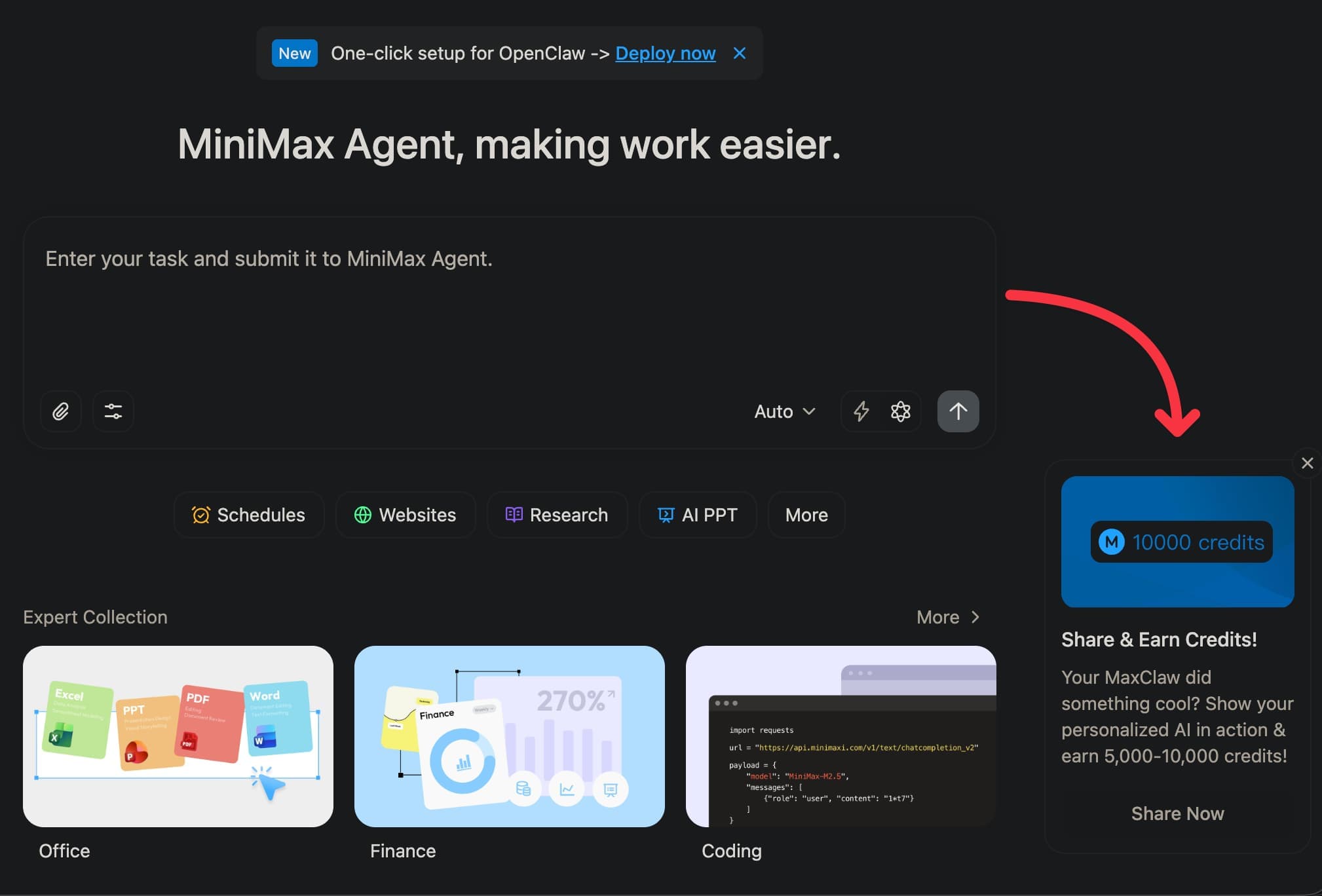
MiniMax lets users share and earn credits through the MaxClaw Showcase Program banner showing 10,000 credits reward
The interesting part isn't the product. It's the growth loop hiding behind a Google Form.
MiniMax just launched what they call the MaxClaw Showcase Program. The pitch: share your MaxClaw experience on social media, earn credits.
Two tiers:
Standard Reward (5,000 credits): Post a use case or a successful example on social media. Keep it live for 24 hours. That's it.
Creative Reward (10,000 credits): Make a video, write an article, or record a podcast. Double the credits for deeper content.
It's like a restaurant that gives you a free appetizer if you post a photo of your meal. The appetizer costs them pennies. The Instagram post brings in 3 new reservations.

MaxClaw Showcase Program Google Form showing reward tiers and participation details
The rules are straightforward. Try new MaxClaw features, show real workflows, and keep examples concrete.
Here's where MiniMax turns a simple credits program into a distribution machine.
They don't just ask you to post anywhere. They tell you exactly where and how:
X (Twitter): Tag @MiniMax_AI, use #MaxClaw #MiniMax Agent
LinkedIn: Tag @MiniMax, use #MaxClaw #MiniMax Agent
Reddit: Use #MaxClaw #MiniMax Agent
YouTube: Use #MaxClaw #MiniMax Agent
Every post requires specific hashtags and brand tags. That's not a suggestion. It's a requirement for getting paid via credits. Remember, every social media platform is a search engine in disguise.
Every piece of user content becomes a branded search signal across 4 platforms simultaneously. Same mechanic as tweet for discount, just with credits instead of a coupon code.
Superhuman ran a similar play: tweet about the product, get a free month.
Giga AI gated their waitlist behind a share action while Unroll.me replaced their paywall with a sharewall.
The pattern is the same. Trade distribution for access.
Same energy as a gym that gives you a free month if you bring a friend who signs up. You think you're getting a deal. The gym just cut its customer acquisition cost by half.
The Loyalty Card Economics of AI Credits
Credits cost MiniMax almost nothing to issue. They're internal currency with no cash-out option. But to the user, credits feel like real money because they unlock compute time on the platform.
This is the same mechanic freemium games have used for years. The marginal cost of giving someone 10,000 credits is close to zero.
It's like a coffee shop loyalty card. Stamping a card costs nothing. But by the time you're 2 stamps away from a free latte, you'll walk past 3 other cafes to get there.
A genuine user testimonial posted across X, LinkedIn, Reddit, and YouTube is worth more than any credit MiniMax hands out.
MiniMax gets:
Authentic social proof from real users
Algorithmic visibility through mandatory hashtags and trending page
Multi-platform distribution without paying for ads
Content that looks organic because it is organic
The user gets credits. MiniMax gets a marketing army.
The Form That Doubles as Market Research
After posting, users fill out a submission form with their UID, email, country, industry, and a link to their post. MiniMax reviews content quality within 24 hours and adds credits to the account.
But look at what MiniMax actually collects through that form: user IDs, email addresses, countries, industries of work, and direct links to the content those users created.
That's a full user profile attached to a piece of organic marketing.
Most companies pay research firms thousands of dollars for this kind of data. MiniMax gets it for free, wrapped inside a rewards program that users volunteer for.
They know who their power users are, what industries they work in, which use cases resonate, and which platforms drive the most engagement.
The credits program is the front door. The data is the back room.
Steal This Credits-for-Content Playbook
You don't need to be MiniMax to run this play. Any product with an internal credit system can do the same thing:
Pick 3-4 platforms where your users already hang out
Define specific hashtags and tagging rules so every post feeds your brand's search footprint
Set 2 reward tiers: easy (share a screenshot) and deep (make a video or write something)
Collect submissions through a form that also captures user data
Review within 24 hours to keep the flywheel spinning
FireCrawl ran a similar credits-for-follows play during onboarding. OpenArt AI used activity-based credits to drive feature adoption. The mechanic scales across any product with internal currency.
The credits cost you nothing. The distribution costs you nothing. The social proof is real because real users made it.
Most companies pay agencies to manufacture testimonials. MiniMax is paying in Monopoly money and getting the real thing.
Top Tweets of the day
1/
Always be A/B testing!!!
2/
There is no reason not to do videos anymore. If you didn't want to be famous, even faceless works now.
3/
Always be learning but implement 3-5x more than you learn otherwise the knowledge evaporates.
Rabbit Holes
What’d ya think of today’s newsletter? Hit ‘reply’ and let me know.
Do me a favor and share it in your company's Slack #marketing channel.
First time? Subscribe.
Follow me on X.
More Startup Spells 🪄
Browse Traffic vs. Search Traffic: Study of YouTube Tutorial Channel Performance (2 Years of Data) (LINK)
Ahrefs' alternative to the boring Chrome Extension Uninstall Survey (LINK)
How Gamifying Failure Increased Chess.com Subscriptions by 20% (LINK)
How Basecamp's PR Strategy Generates Millions in Free Press (LINK)
How Alex Hormozi Uses the Kevin Hart Meme to Revive Dead Leads (LINK)
Reply