- Startup Spells 🪄
- Posts
- Lucky Strike's "It's Toasted" Ad: The 2-Word Strategy That Outsold Every Health Claim
Lucky Strike's "It's Toasted" Ad: The 2-Word Strategy That Outsold Every Health Claim
PLUS: Rockefeller's Autobiography

Startup Spells 🪄
April 14, 2026
In 1960, a fictional ad exec named Don Draper sat in a boardroom with no ideas, a room full of tobacco executives, and a crisis. Cigarettes had just been linked to cancer. Every competitor was scrambling to fight the science.
Don ignored all of it and wrote 2 words on a napkin. That scene from the Mad Men pilot became one of the most studied Lucky Strike "it's toasted" ad moments in pop culture. But the real strategy behind it is even better than the fiction.
Don: This is the greatest advertising opportunity since the invention of cereal. We have six identical companies making six identical products. We can say anything we want. How do you make your cigarettes?
Lee Garner, Jr.: I don't know.
Lee Garner, Sr.: Shame on you. We breed insect-repellent tobacco seeds, plant 'em in the North Carolina sunshine, grow it, cut it, cure it, toast it.
Don: There you go. There you go. [He writes: "Lucky Strike. It's Toasted."]
Lee Garner, Jr.: But everybody else's tobacco is toasted.
Don: No, everybody else's tobacco is poisonous. Lucky Strike's is toasted.
Two words. That was all it took. The room went from panic to applause. But the real brilliance wasn't the slogan itself. It was the strategy underneath it.
The Misdirection Nobody Saw Coming
Every other cigarette company in that room (fictional or not) was doing the same thing: fighting the health scare head-on. Running ads about throat doctors. Citing studies. Trying to prove cigarettes were safe.
Lucky Strike ignored all of it.
Don didn't argue that cigarettes were healthy. He didn't acknowledge the Reader's Digest article that had just linked smoking to cancer.
He changed the subject entirely. While every competitor scrambled to defend the product, Lucky Strike talked about how it was made.
"It's toasted" isn't a health claim. It isn't a lie. It's a simple, true description of a manufacturing step.
But in the context of an industry drowning in health panic, a calm, warm message about toasting felt like reassurance. As Don put it: "Advertising is about happiness. Freedom from fear."
A billboard on the side of the road that screams with reassurance that whatever you're doing is okay.
The slogan didn't say Lucky Strike was safe. It just stopped you from thinking about danger.
2 Syllables, Zero Logic, Full Buy-In
Why "toasted" specifically? Any step of the manufacturing process could have been the slogan. "It's cured." "It's sun-grown." "It's blended." None of those would have worked the same way.
"Toasted" hijacked stored memories. By the 1910s and 1920s, toasters were in nearly every American kitchen.
The word triggered images of bread, breakfast, butter melting into English muffins, mom at the kitchen table. Warm, domestic, harmless.
Not cancer sticks. Not poison. Toast.
That single word bypassed logic entirely and went straight to feeling. The brain doesn't debate feelings. It just accepts them.
It's the same reason Starbucks pumps the smell of fresh coffee through every store. The drink might be overpriced. The line might be long.
But when you walk in and catch that warm roast in the air, your guard drops. You stop calculating and start craving. "Toasted" did the same thing, just with 2 syllables instead of an espresso machine.
First-to-Claim: Own the Obvious
Here's the part that trips people up. Every cigarette brand toasted its tobacco. It was a standard step in manufacturing. Lucky Strike didn't have a unique process.
It didn't matter.
What mattered was that Lucky Strike said it first. They stamped a mundane, universal fact in all caps on their packaging: "IT'S TOASTED."
Once claimed, that phrase belonged to them. Other brands could have made the same statement, but they hadn't. And once Lucky Strike owned it, any competitor who tried to say the same thing would sound like a copycat.
It's like being the first person in class to raise your hand with the right answer. 3 other students knew it too. But you said it out loud, so the teacher remembers you. The knowledge was shared. The credit wasn't.
This is the tactic: find a true thing about your product that every competitor also does, but nobody talks about.
Then talk about it loudly, before anyone else can. The audience doesn't know it's universal. To them, it sounds like a differentiator.
The Real "It's Toasted" Story Starts in 1917
The TV version is great storytelling. But the real campaign predates it by decades. "It's Toasted" first appeared around 1917.
Susan Wagner documented the origin in her 1971 book Cigarette Country. The slogan wasn't born out of a health crisis at all. It was born out of a market share war with Camel cigarettes after World War I.
R. J. Reynolds had ridden burley tobacco to 40% of U.S. cigarette sales by 1918. Burley tasted stronger and nuttier than the Virginia tobacco most brands used. When the war cut off Turkish tobacco imports, smokers switched to Camels. American Tobacco was losing ground fast.
Their answer was Lucky Strike, a brand that had existed since 1871 (named after the California Gold Rush). As Wagner writes:
A new package was designed, with its famous bull's-eye in the center, and a sales campaign devised around the slogan "Lucky Strike, It's Toasted." That idea came to [American Tobacco president Percival] Hill when a vice president in charge of manufacturing remarked that the amount of heat used in making cigarettes was equivalent to cooking. Lucky's first advertising campaign shows a piece of toast with a fork stuck through it. This was the start of one of the most expensive, if not the most expensive, sales campaigns in merchandising history.
It's the marketing equivalent of a restaurant putting house-made on the menu. Every restaurant makes their food in-house. That's what a kitchen is for.
But writing it down makes it feel intentional, special, considered. Percival Hill did the same thing with toasting: took a step every factory already performed and turned it into a selling point.
The first Lucky Strike "it's toasted" ad leaned heavily into that toast imagery. A hand holding a toasting fork. A piece of bread on a circle.
The message sat next to copy that read: "Think of a cigarette served to you as appetizingly as the hot, buttered toast that comes to your breakfast table."
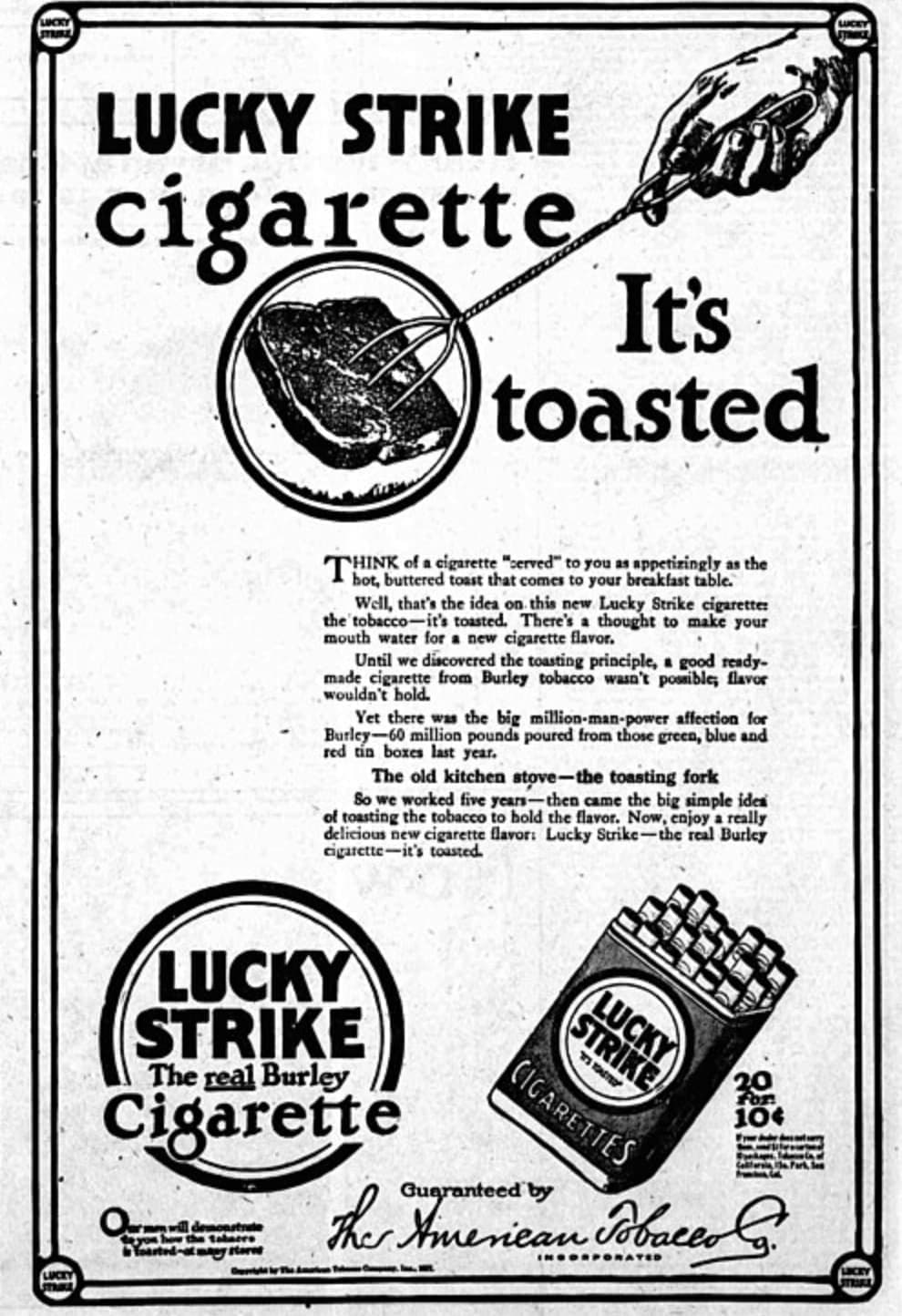
Lucky Strike "it's toasted" ad from 1917 showing a piece of toast with a fork
The Mad Men version cut the toast. Matt Weiner probably thought bread imagery lacked sex appeal. Fair point.
But the real campaign was more grounded than the TV version. It leaned hard on agriculture. Lucky Strike called itself "The real Burley Cigarette," and in 1917, people knew enough about tobacco varietals for that to matter.
Over the following decades, the campaign evolved. Celebrity endorsements replaced the rustic toast fork. Golfers and actors lent their faces to the "It's Toasted" line.

Lucky Strike mid-century ad featuring golfer Sam Snead with the "It's Toasted to taste better" tagline
The gamble paid off. Lucky Strikes became the best-selling cigarettes in the nation. A 1929 ad declared that "An Ancient Prejudice Has Been Removed," claiming the toasting process eliminated harmful irritants from the tobacco.
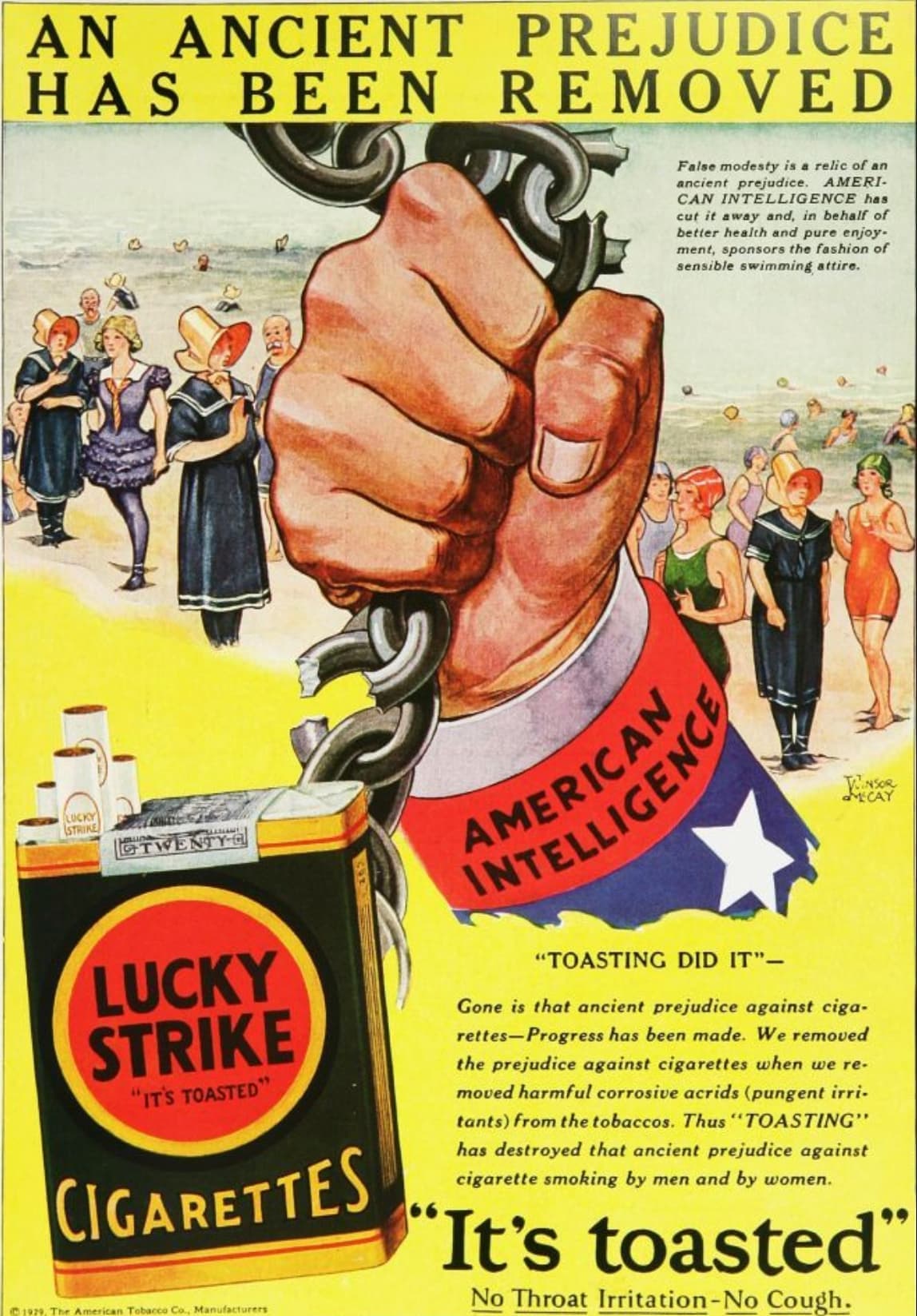
Lucky Strike 1929 ad promoting how toasting removed "harmful corrosive acrids" from tobacco
The brand is still sold in the United States today.
Some brands are like that jacket you bought in college that somehow still fits 15 years later. The stitching held. The style aged well.
Lucky Strike's slogan has been running for over a century because the strategy underneath it never went out of fashion.
This exact playbook shows up everywhere in modern marketing. The product doesn't change. The framing does.
Dove doesn't sell soap. Dove sells the feeling of being beautiful. Their ads focus on revealing a woman's inherent beauty by keeping her skin healthy. The soap is incidental. The emotion is the product.
Foster's beer is considered cheap in Australia. Aussies can barely stand it. In the United States, all it took was "Foster's: Australian for beer" and the brand became a hit. Same liquid, different story.
Cookie Crisp is a breakfast cereal that is manufactured to look like chocolate chip cookies. The box art would have you believe it's a healthy, nutritious breakfast.
Bill Bryson wrote about being overwhelmed in the American cereal aisle and realizing that Cookie Crisp was just a way to sell cookies at breakfast. The product didn't change. The context did.
Every one of these follows the same pattern that Lucky Strike pioneered over a century ago: take what your product already is, find the angle nobody has claimed, and say it first.
Top Tweets of the day
1/
Study a little bit of social engineering and you can get a lot of info out of your competitors easily.
And the best part is you won't get caught like this.
This 3-minute movie scene captures the best of social engineering.
2/
When you jump on trends, cash out as fast as possible.
Lovable is a good example. They would've made a killing if they sold an annual plan based on specific credit usage per month.
It is still making a killing but can easily buy out lots of LTV from customers who jumped on it based on hype.
3/
Good example vs bad example on how to write copy.
Rabbit Holes
What’d ya think of today’s newsletter? Hit ‘reply’ and let me know.
Do me a favor and share it in your company's Slack #marketing channel.
First time? Subscribe.
Follow me on X.
More Startup Spells 🪄
Showtime's Churn Prevention Secret Tactic: 60-40-20 Discount Loophole (LINK)
How an AI Prompt-Engineering Growth Tactic Drove 31,548 GitHub Stars (LINK)
How Alex Finn Successfully Pivoted His X Niche After Building 100K+ Followers (LINK)
Grammarly Monetization Case Study: How "Premium Feature Sampling" Doubled Conversions (LINK)
LinkedIn Post Generator: How a Parody Tool Went Viral, Got 2M Users & Sold in 7 Days (LINK)
Reply