- Startup Spells 🪄
- Posts
- Interest Graph vs Follower Graph Algorithm
Interest Graph vs Follower Graph Algorithm
PLUS: 13 Facebook Ad Angles That Scale

Startup Spells 🪄
December 04, 2025
Zendesk Customer Experience (CX) Trends 2026 Report

Zendesk CXtrends 26
74% of customers are frustrated repeating themselves across channels. Memory-rich AI can fix this. Get the CX Trends 2026 report to learn how contextual intelligence drives smarter experiences.
This is an advertisement.
Interest Graph vs Follower Graph Algorithm
The interest graph algorithm has effectively killed the era of generalist content creation. It works very differently from the old follower graph algorithm world most of us grew up in.
10 years ago, you built an audience based on who you knew. Facebook and Instagram ran on the Social Graph. If someone followed you, they saw your lunch, your political rant, and your business advice. The connection was the person.

The social graph algorithm shows content based on user connections
Then TikTok arrived and changed the math.
TikTok introduced the Interest Graph. This model ignores who you follow. It looks strictly at what you consume. If you watch a video about SaaS, you get 10 more videos about SaaS. The creator’s identity matters less than the topic relevance.

The interest graph algorithm groups users by consumption habits
This shift has bled into YouTube, X (Twitter), and even Google. The days of "publishing anything" are over.
"You grew your account during a time when social graphs were follower based. Now social graphs are interest based. Followers mean nothing. Content does." ~ Isaac, Founder of Mini Katana, 22 million YouTube subscribers.
Why Alex Hormozi Abandoned Fitness-Related Content
Creators often chase "Total Addressable Market" (TAM) because they want big numbers. They think wider topics equal more views.
But it's not true.
Alex Hormozi used to cover fitness, diet, and dating. Those topics have massive mass algorithm appeal. They got him millions of views. But views do not equal money.

Eric Siu explains why high TAM content like relationships doesn't convert for business
Siu noted that a podcast episode with 520,000 views brought him zero leads for his ad agency. Broad content attracts the wrong people.
When you narrow your focus, you lose the tourists. You keep the buyers.
8 Creators Who Make Millions By Posting About One Thing
You can actually see the interest graph in action if you browse a few channels. Each one has picked a lane and stayed there.
The algorithms now reward creators who stay in their lane. You need to signal to the machine exactly what you are about.
Denis Shatalin: B2B SaaS or nothing
Look down Denis Shatalin’s video list on his channel, Denis Shatalin on YouTube. The phrase “B2B SaaS” is everywhere.

Denis Shatalin B2B SaaS channel as example of interest based social media strategy
This B2B SaaS paid marketing strategy made my clients over $65M
How to build a $100k MRR B2B SaaS business with ads
How to sell high-ticket SaaS with Facebook ads
When a title does not say “B2B SaaS”, the topic is still B2B-heavy: cold email, sales calls, LinkedIn for SaaS founders. But the video specifically mentions "B2B SaaS" even when the title does not.
He is teaching the algorithm a very clear lesson: this channel equals B2B SaaS growth.
So when someone searches “B2B SaaS marketing” or watches a few B2B SaaS videos, Denis is a safe suggestion. The machine knows exactly who should see his content.
Laurel Portié: Facebook Ads all day
Laurel Portié does the same thing for Facebook Ads on The Laurel Show.
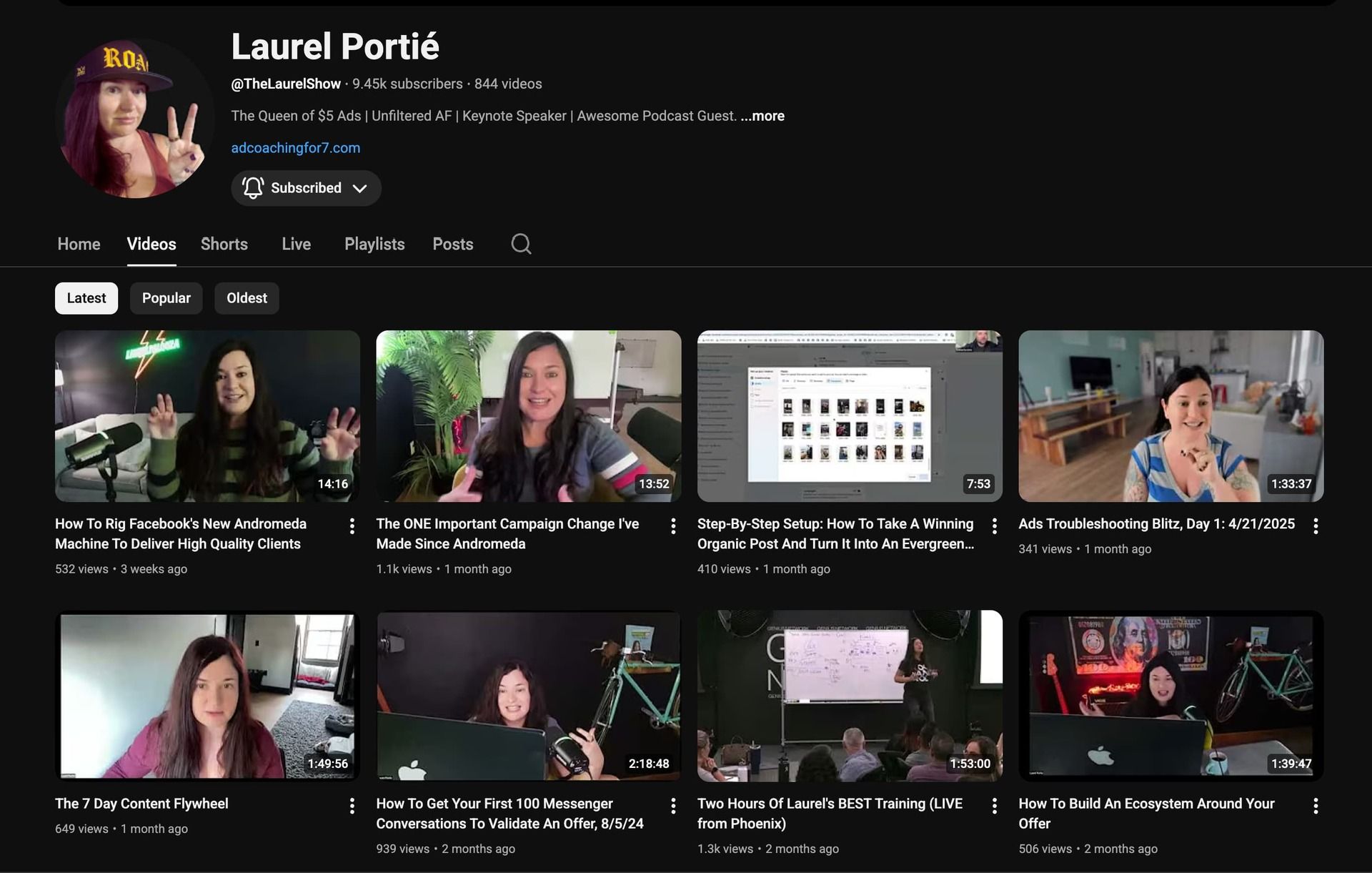
Laurel Portie YouTube channel focused on Facebook Ads training
Every thumbnail screams “FB Ads”. Every headline contains the phrase.
How To Rig Facebook’s New Andromeda Machine To Deliver High Quality Clients
The ONE Important Campaign Change I’ve Made Since Andromeda
If you are the interest graph, her bucket is obvious. She is the Facebook Ads specialist, not a general marketing person with occasional ad tips.
Alex Becker Business: Facebook Ads
Alex Becker learned this the hard way.
He originally had a mixed channel where he discussed everything from personal development to cryptocurrency. It was a mess of signals. The algorithm had no idea how to categorize him.

Alex Becker's old channel with mixed topics from crypto to self-help
When he wanted to promote his ad-tracking software, Hyros, he didn't try to fix the old channel. He started a new channel.

Alex Becker's new channel focused strictly on business and SaaS
This new channel focuses explicitly on business and SaaS. He trained the interest graph algorithm from day one to associate him with high-ticket software sales so he can run ads to people who watch ad-related content on YouTube.
If you have 2 interests, you need 2 channels.
Edward Sturm: from general marketing to SEO
Edward Sturm spent years posting all sorts of things on his YouTube channel. Startups, travel, experiments, general marketing.

Edward Sturm YouTube channel focused on SEO topics
In a retrospective on his podcast growth, he revealed that he struggled for over a year while talking about "life, business, and marketing."

Edward Sturm details his pivot to SEO-only content in March 2025
In Mid-March 2025, he finally cut the cord. He narrowed his focus from general marketing to strictly SEO content.
He admitted the difficulty: "I was reluctant to do this because I like talking about a variety of topics."
We all do. Being a specialist feels boring. But the moment he accepted the boredom and niched down, his growth unlocked. He stopped trying to entertain everyone and started solving specific problems for a specific group.
Alex Hormozi: fewer views, more applications
Alex Hormozi started out talking about fitness and diet along with business on his channel.

Alex Hormozi YouTube channel focused on business and acquisition.com
Older videos cover protein intake and workout routines. That content gathered broad mass-market views, but did not send many qualified applications to his firm Acquisition.com.
Hormozi realized this. He stopped talking about protein shakes and relationships. He pivoted back to business.
Now the titles read:
Watch This To Generate 1000s of Leads (In Any Niche)
How to Build a Business That Makes You Free
The view counts on individual videos dropped to only ~100k views per video instead of 1 million per video, but the applications for Acquisition.com went up.
The interest graph sees him as a business person.
App Masters: mobile app marketing only
App Masters is a textbook interest graph channel.
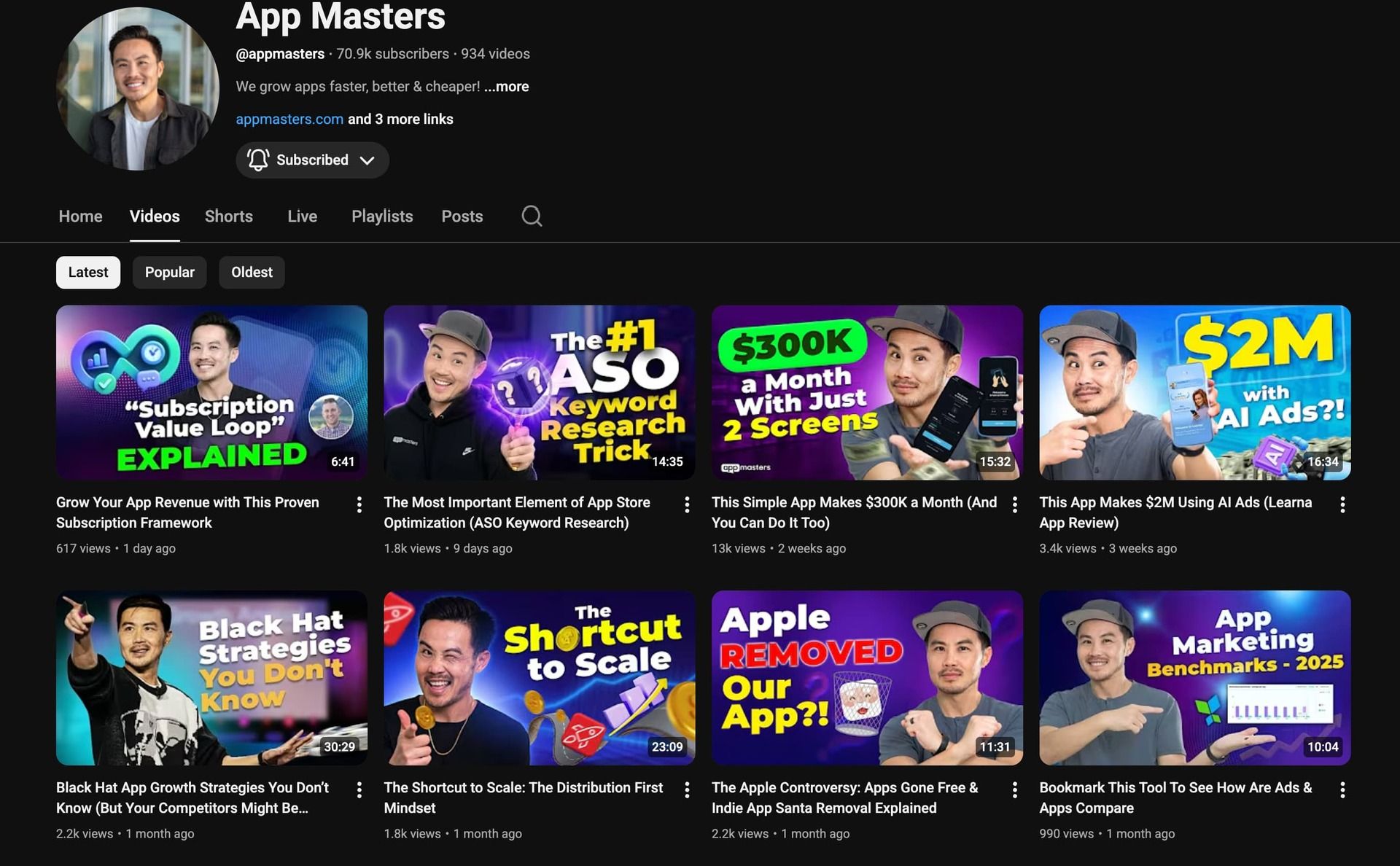
App Masters YouTube channel focused on mobile app marketing and ASO
Every video speaks to the same person: someone who is trying to grow a mobile app.
App Store Optimization
Google Play ranking
Subscription funnels
Ad campaigns for apps
They talk about many subtopics, but always inside the same container: mobile app marketing.
MrBeast: content for kids
MrBeast follows the same pattern.

MrBeast YouTube channel with kid-focused challenge videos
He posts kid-focused challenge videos, giant stunts, extreme scenarios.
The algorithm knows he makes high retention content for a young, entertainment-hungry audience. When someone watches one of his videos, YouTube knows exactly what to show next.
Starter Story: entrepreneurship hopium
Starter Story does this for entrepreneurship hopium.

Starter Story YouTube channel with entrepreneurship hopium thumbnails
Titles and thumbnails clearly shows money-made:
My website makes $35K/month (built in 3 hours)
How I Built It: $400K/Month Mobile App
It is all the same emotional promise: “You too can build one of these”. Different businesses, same feeling.
This is not limited to video. Google has updated its ranking logic to punish sites that lack topical authority.
HubSpot used to be the king of publish anything that ranks. They wrote articles about famous quotes, resignation letters, and generic productivity tips. These pages brought in millions of visitors.
Then the floor fell out.

HubSpot traffic graph showing a massive drop in organic views
HubSpot sells CRM software. Google decided that a CRM company has no business ranking for "best famous quotes." Their traffic on unrelated pages collapsed.
Matt Diggity analyzed this drop in rankings.
His conclusion is simple: if you sell fishing gear, you must become the expert on fishing. If you start writing about crypto on your fishing site, you drag the whole ship down.
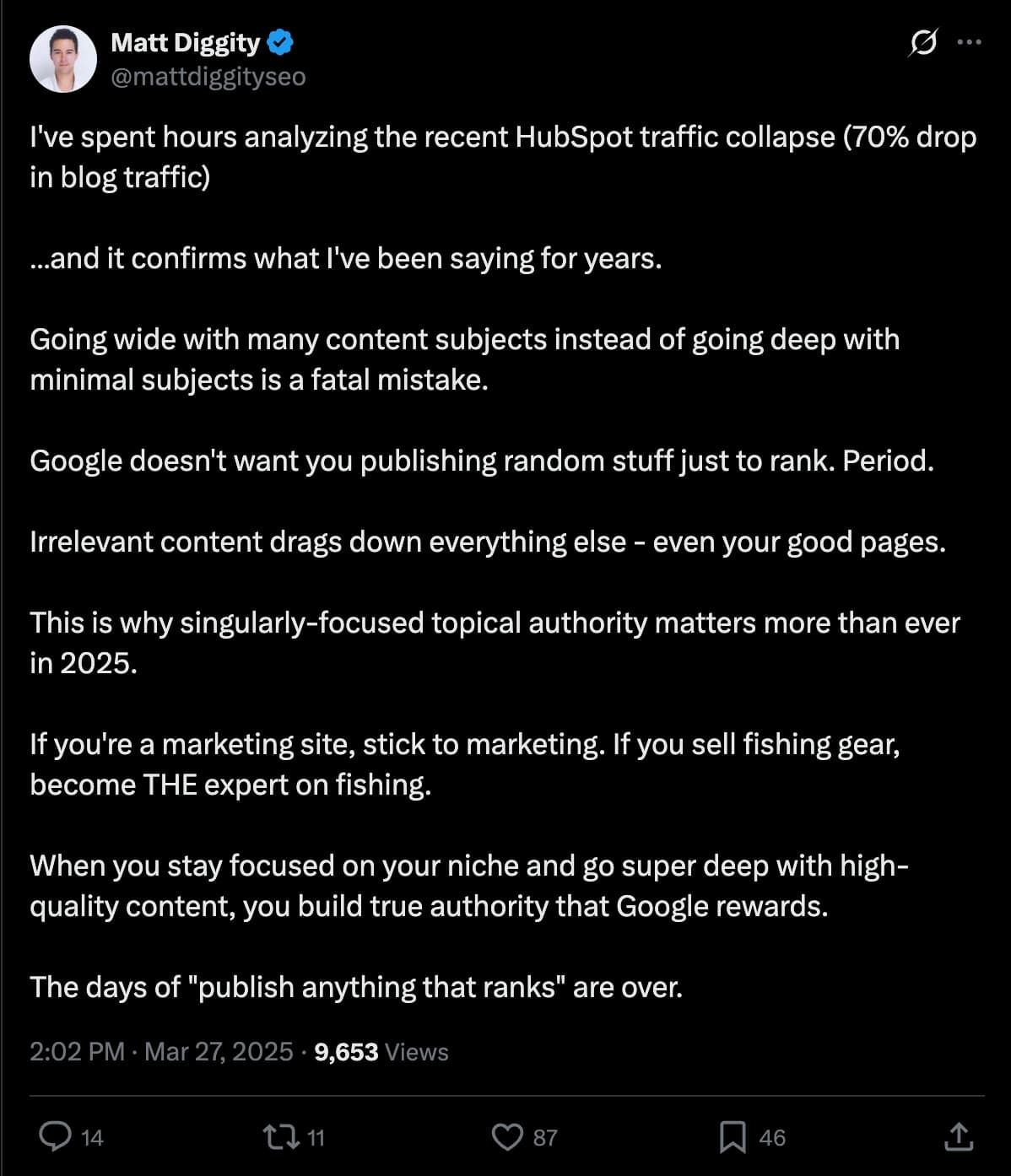
Matt Diggity explains the importance of topical authority for SEO
Irrelevant content dilutes your authority.
Your Audience Doesn't Care About Your Hobbies
I see this in my own newsletter data.
Most issues focus on SaaS growth, marketing systems, and experiments that help people do their job. Those issues bring replies and new subscribers.
Then, once in a while, I write about something that has nothing to do with SaaS. An old-school marketing trick that a horror-movie used.
Those issues trigger the highest unsubscribe spikes.
Nothing was wrong with the content. It simply answered a different question than the one people signed up for.
They joined for SaaS help. They received a film campaign story.
On social, the same thing happens, but silently. People do not unsubscribe. They just ignore the off-topic content. The algorithm notices the drop in engagement and quietly stops pushing your posts.
That is audience mismatch.
The market has spoken. Generalists are out. Specialists are in.
Pick your topic. Stick to it. Let the algorithm do the rest.
TikTok laid this playbook. Now X, YouTube, Google, and the rest are following it.
Top Tweets of the day
1/
Most creators are flaky with their posting schedules since they are mostly college kids with little to no work ethic. Streaks and bonuses are good incentives against this.
2/
#2 type landing pages convert well because they show the app in action behind the blurred screen. Typefully does it too.
3/
Good way to ragebait to get people behind you for a cause. Remember to pick up a big enemy as you only need to do it once to gain a huge following and then use them as your engagement engine to get the audience you want.
Beef Marketing covers more of this stuff.
Rabbit Holes
What’d ya think of today’s newsletter? Hit ‘reply’ and let me know.
Do me a favor and share it in your company's Slack #marketing channel.
First time? Subscribe.
Follow me on X.
More Startup Spells 🪄
How Prayer Lock automates UGC marketing using Gemini 3 & Python (LINK)
Puma's $120k Pelé Deal at the 1970 World Cup (LINK)
Pizza Hut guerrilla marketing: PR on a $500 budget (LINK)
Kalshi influencer marketing: $1,000/month for 12 quote-tweets on X (LINK)
How SEO Roast turns free tools into $5,250 audits (LINK)
Reply