- Startup Spells 🪄
- Posts
- ColorBliss' Programmatic SEO Strategy: How 8,700 AI Pages Captured Long-Tail Search
ColorBliss' Programmatic SEO Strategy: How 8,700 AI Pages Captured Long-Tail Search
PLUS: Ask a philosopher about AI

Startup Spells 🪄
January 02, 2026
ColorBliss is a masterclass in programmatic SEO. Founder Ben Robertson built an engine that generated over 8,700 AI landing pages, capturing the entire long-tail search market for coloring pages.
It started with a frustrated 5-year-old.
Ben's son wanted a specific coloring page: "Spider-Man riding on a dinosaur, hunting a leopard in the forest."
They Googled it. Nothing.
The kid kept scrolling. "Dad, it's got to be there."
It wasn't.
Traditional coloring page sites are constrained by physics. An artist must draw every line. They offer 50 variations of Spider-Man standing still. But kids imagine infinite combinations.
That gap between a child's imagination and a human artist's output is the size of the entire internet. Ben didn't hire a studio of illustrators. He built a programmatic SEO engine backed by AI image generation.
Today, those 8,700+ indexed pages target specific long-tail queries. Each one converts organic traffic into paid subscriptions.
The result: a bootstrapped side project generating an estimated $30,000 to $100,000 in monthly recurring revenue. One developer. Zero employees.
The recursive permutation model
ColorBliss uses a combinatorial content model. They don't write pages one by one. They multiply entities by settings.
The formula: Character × Action/Setting = Unique Landing Page
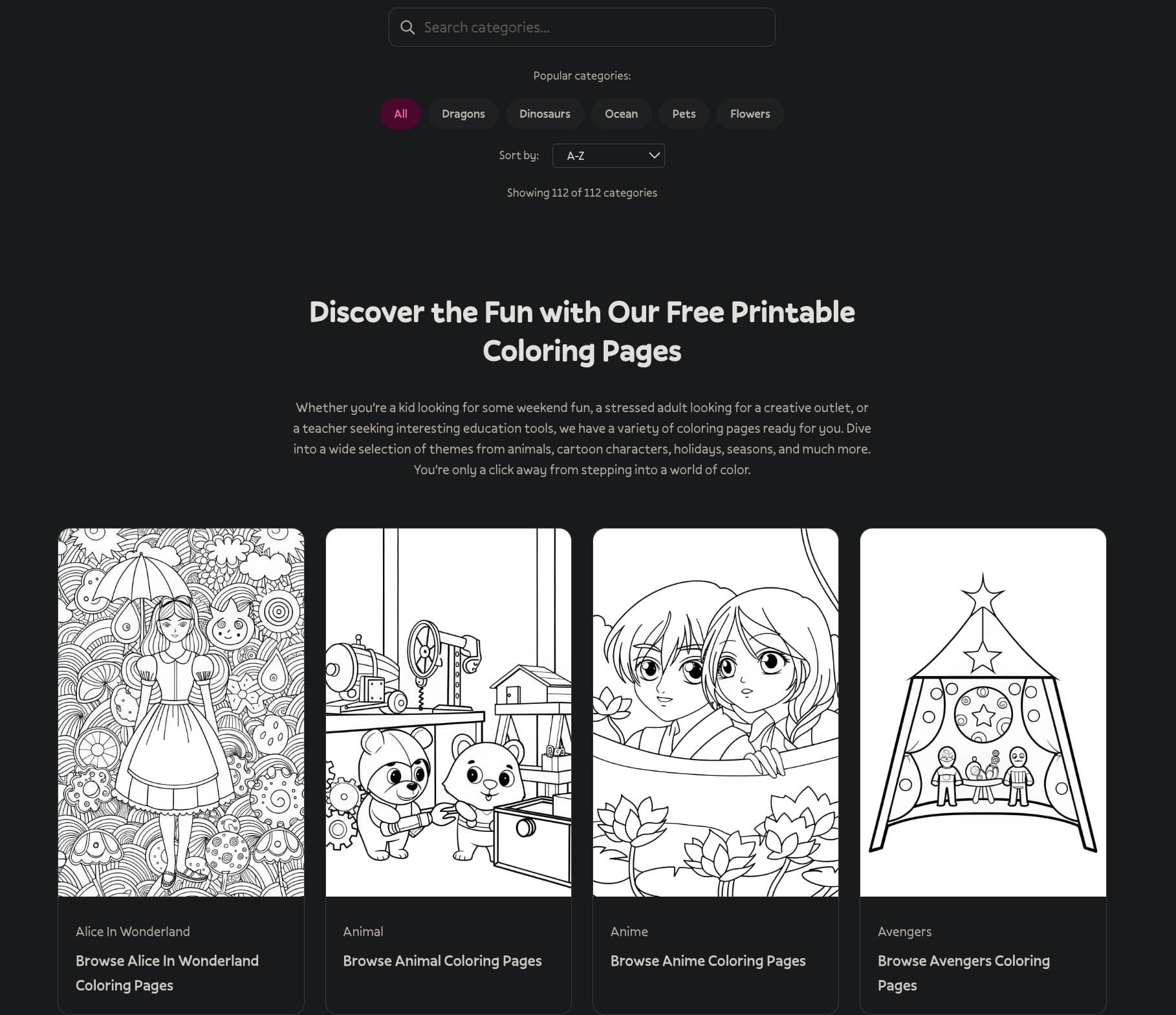
Look at the Yoshi coloring pages hub.

ColorBliss - Yoshi coloring pages showing recursive permutation strategy
The structure:

ColorBliss - Yoshi floating through bubbles Coloring Page
This works for any character. The Batman category follows the same logic.

ColorBliss - Batman coloring pages showing recursive permutation strategy
The variation creates exponential advantage.
One character × 50 scenarios = 50 pages.
100 characters × 50 scenarios = 5,000 pages.
Each page ranks for 3–10 keyword variations. A single programmatic system can target 50,000+ keywords. Ben didn't write 8,700 pages. He wrote one script that generated them.
The topic cluster architecture
Google hates spam. If you generate 8,700 pages and dump them in your root directory, you look like a content farm. You get penalized.
ColorBliss organized the chaos into strict topical hierarchies.
Tier 1: Hub Page — colorbliss.com/free-coloring-pages/
Tier 2: Character Cluster — colorbliss.com/free-coloring-pages/yoshi-coloring-pages/
Tier 3: Specific Page — colorbliss.com/free-coloring-pages/yoshi-coloring-pages/yoshi-floating-through-bubbles
ColorBliss URL structure showing character-specific subdirectories
When Google crawls the site, it sees a logical pyramid. The hub links to the character. The character links to 50 specific scenarios. The specific scenarios link back to the character.
PageRank flows efficiently through the system. Google understands that ColorBliss isn't a site with a random Yoshi page. It is the authority on Yoshi coloring pages.
Sitemap strategy for massive indexation
Generating pages is easy. Getting Google to index them is hard.
Google limits standard sitemaps to 50,000 URLs. Most sites hit the ceiling or face crawl budget issues. ColorBliss built around this using a sitemap index structure.
They split their sitemap:
/sitemaps/static/sitemap.xml
/sitemaps/blog/sitemap.xml
/sitemaps/coloring-pages/sitemap.xml
/sitemaps/generators/sitemap.xml
By breaking the site into bite-sized chunks, they ensured Googlebot could digest the content without choking. Every character page got found. Every page got indexed.
The AI image generation cost advantage
Traditional coloring sites have a hard economic limit.
The Human Cost:
Item | Cost |
|---|---|
Hire artist | $25–$75 per page |
Speed | five pages per day |
Cost for 1,000 pages | $25,000+ |
The AI Cost:
Item | Cost |
|---|---|
API cost | $0.05–$0.15 per generation |
Speed | 100+ pages per hour |
Cost for 1,000 pages | $150 |
That is a 166× cost reduction.
Ben didn't automate the writing. He automated the product. When a new Disney movie drops, traditional sites scramble to hire artists. ColorBliss can generate 75 themed pages in six hours for the price of a coffee.
Because the marginal cost of content is effectively zero, ColorBliss can afford to target keywords with only 10 searches a month. A human artist can't afford to draw for 10 people. An API can.
The directory backlink cascade
Programmatic SEO needs domain authority to work. New sites usually stay in Google's sandbox for months.
Ben accelerated this by listing ColorBliss on There's an AI for That in October 2023.
He didn't realize it at the time, but this was a force multiplier. Thousands of smaller AI directories scrape the major ones to populate their own lists.
One submission generated 1,000+ backlinks.
These weren't high-value editorial links from the New York Times. But they were relevant, categorical links from the AI ecosystem. They provided enough initial signal to get the 8,700 programmatic pages indexed.
Revenue timeline: from launch to $100,000 MRR
Traffic is a vanity metric. Revenue is the truth.
Ben documented his journey publicly:
September 2023: Launched.
February 2024: $500 monthly revenue.
Spring 2024: The tipping point. One organic customer per day.
September 2024: $6,300 monthly recurring revenue.
The key realization wasn't the total number. It was the consistency.
"If I can get one customer every day, I think I can get 3 customers every day," Ben noted. "And if I can get 3 customers every day, then I can make this an actual sustainable business."
He validated the model with paid ads and Pinterest traffic, but organic search remained the primary driver.
Based on his growth trajectory since the final public revenue share, estimates place ColorBliss between $30,000 and $100,000 MRR.
Programmatic patterns you can copy
You don't need to build a coloring book to use this strategy. The mechanics apply to any industry with high-variation inventory.
1. The combinatorial database
Identify an entity that can be modified.
Zillow: City × Neighborhood × Property Type
ColorBliss: Character × Setting × Action
Resume Builders: Job Title × Industry × Design Style
2. The free value hub
Give away the programmatic content to rank. Charge for the tool that creates it.
ColorBliss gives away the static image. If you want to customize it, you subscribe.
3. The generator diversification
Once the core engine works, clone it for adjacent intents. ColorBliss built separate generators for Bible verses and bubble letters.

ColorBliss specialized generators for adjacent keyword clusters
Different keywords. Different audiences. Same underlying tech.
4. The universal formula
If you want to replicate this, look for visual content that requires endless variations:
Wedding invitation templates (style × theme × color scheme)
Presentation templates (topic × industry × visual style)
Social media graphics (platform × use case × theme)
Printable planners (year × type × layout)
Worksheet generators (subject × grade level × topic)
Logo variations (industry × style × color palette)
Figma executed the same combinatorial strategy with their Color Meanings directory. They created pages for "dark pink," "navy blue," and "forest green." Figma captured 274,000 organic visits in 90 days.
Ben Robertson proved you don't need Figma's budget to run Figma's playbook. The moat isn't the content anymore. The moat is the system that builds the content.
Top Tweets of the day
1/
Took me too long to realize this. Rules are just guidelines.
Everything is legal if you scale it up. The big tech you use broke laws in their early days.
2/
Best agency niche right now!
3/
This is how you run SEO agents in the wild. 2026 is gonna be the year of agents.
What John is doing, everyone will be doing in 2026. He's early.
Rabbit Holes
What’d ya think of today’s newsletter? Hit ‘reply’ and let me know.
Do me a favor and share it in your company's Slack #marketing channel.
First time? Subscribe.
Follow me on X.
More Startup Spells 🪄
Fingerprint's Homepage Personalization Strategy (LINK)
The YouTube Mafia: How 4 Channels Built a YouTube Monopoly in India (LINK)
Increase Dwell Time Using Black Hat SEO Tactics (LINK)
Influencer Collaboration Strategy That Built Unsplash Collections (LINK)
How SEO Roast turns free tools into $5,250 audits (LINK)
Reply