- Startup Spells 🪄
- Posts
- Neurogum's Cross-Channel Growth Loop: How TikTok Feeds Amazon, Google, and Retail
Neurogum's Cross-Channel Growth Loop: How TikTok Feeds Amazon, Google, and Retail
PLUS: Watch Me LIVE Build a Viral UGC Strategy (Consumer Apps)

Startup Spells 🪄
March 31, 2026
Neurogum's Cross-Channel Growth Loop: How TikTok Feeds Amazon, Google, and Retail
Neurogum's cross-channel growth loop starts with a single bet: pour everything into TikTok and let the demand spill into every other channel.
Kent Yoshimura, co-founder and CEO, built this system over the past 3 years. It turned Neurogum into a top 50 health and household product on Amazon. They outsell 5-Hour Energy. They spend zero on Amazon ads.
The logic is counterintuitive. Instead of optimizing each channel separately, Neurogum feeds one channel aggressively and lets the rest grow on their own.
TikTok Powers 4 Revenue Channels
Most brands run their marketing in silos. TikTok team. Google team. Amazon team. Each one with its own budget, its own ROAS target, its own optimization loop.
Neurogum threw that model out. They made TikTok the single demand engine for the entire business: 80% top-of-funnel awareness, 20% bottom-of-funnel conversion.
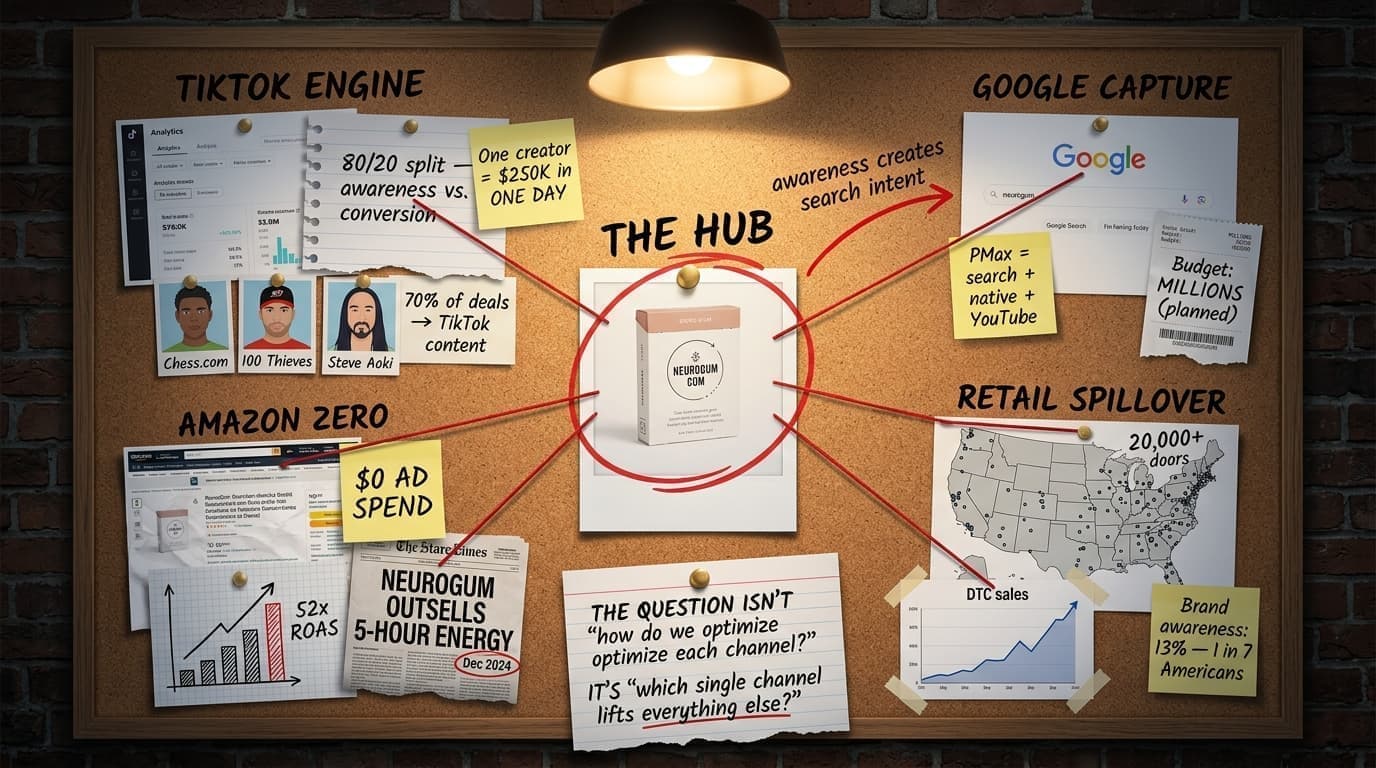
Neurogum Cross-Channel Flywheel: TikTok to Amazon to Retail
A Nielsen Epsilon Meltwater study confirmed the results as mentioned by Kent himself. Neurogum reached 13% brand awareness across the United States. One in 7 Americans recognize the brand. The primary driver was TikTok.
Even their partnerships feed the same system. Chess.com, 100 Thieves, Steve Aoki: Kent says 70% of these deals are structured specifically so creators can turn them into TikTok content.
It's the difference between buying a billboard on a highway and buying a billboard that people photograph and text to their friends. The Chess.com sponsorship isn't the ad. It's the raw material for hundreds of ads.
Before, top-of-funnel partnerships had no clear attribution. You sponsored a chess tournament and hoped it moved the needle somewhere.
Now TikTok gives them a direct feedback signal. If a partnership produces content that performs on TikTok, it's working. If not, it isn't.
Google Captures What TikTok Creates
When TikTok drives awareness, consumers search. They type the product name into Google. That search intent is demand that Neurogum didn't have to pay for.
Neurogum runs Google Performance Max campaigns to intercept it. PMax targets search, native ads, and YouTube all at once. It captures anyone who saw a creator video and then went looking for more.
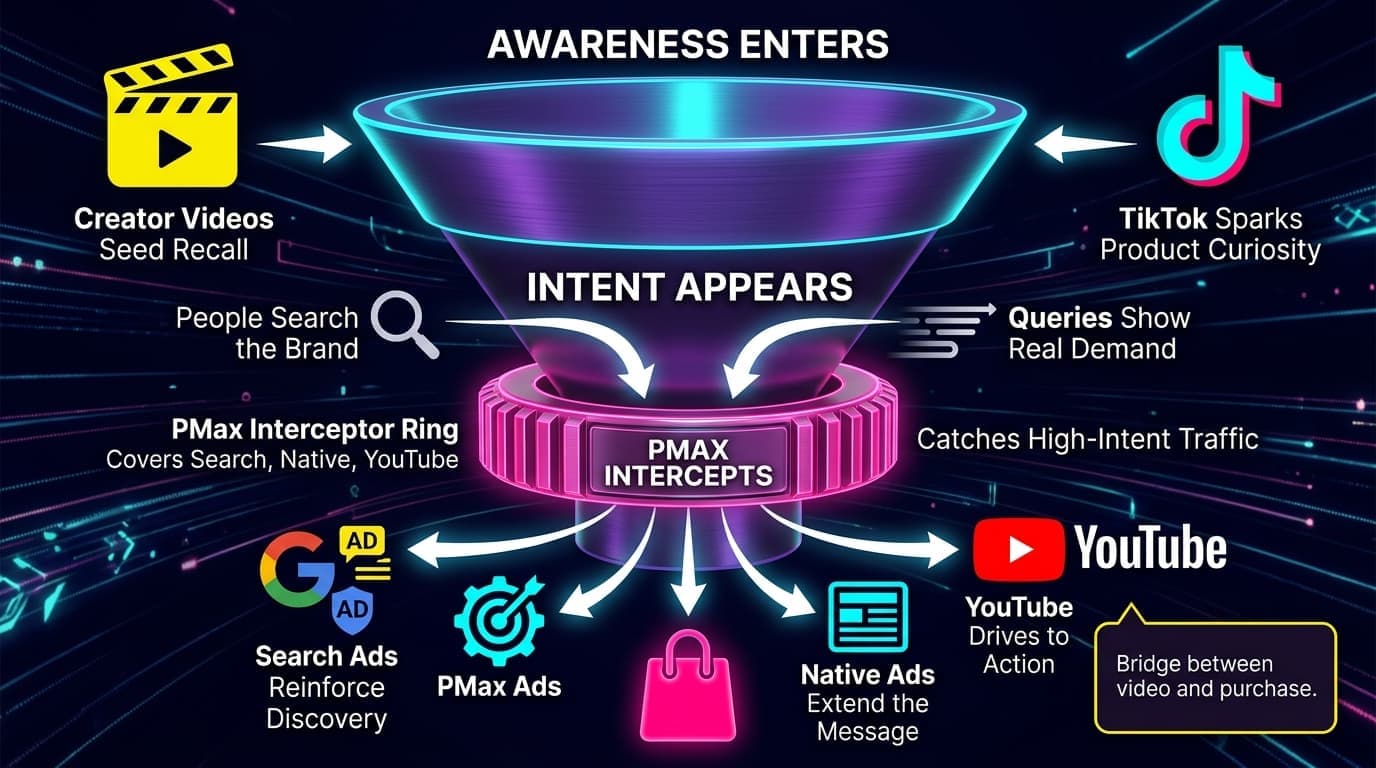
Neurogum Google Pmax demand capture funnel
Kent plans to spend millions on Google because TikTok keeps generating fresh search volume. The more awareness TikTok creates, the more intent Google captures.
Most brands miss this connection. They measure TikTok ROAS by looking at the sales that happen on TikTok itself. Neurogum measures TikTok success by looking at what happens everywhere else.
Google PMax is the bridge between seeing a video and making a purchase.
It's like a bar that puts a food truck in the parking lot. The bar pulls people in with music and drinks. The food truck catches the ones who walk outside hungry. Two businesses, one crowd.
Zero Amazon Ads. 52x ROAS.
The real test came in December 2024. Neurogum cut Amazon ad spend to zero. If TikTok awareness was already pushing people to Amazon, the paid ads on Amazon should be redundant.
It was like turning off the oven light to see if the cake was already baking on its own. If the temperature drops, the oven wasn't hot enough. If it holds, the heat was never coming from the light.
The bet paid off. Amazon ROAS hit 52x with no ad spend. They held the number 1 spot in their category and kept outselling 5-Hour Energy on the platform.
The lift showed up across the board. DTC sales went up. Retail velocity increased across 20,000+ doors. On TikTok Shop, a single creator generated $250,000 in one day during the December new arrivals event.
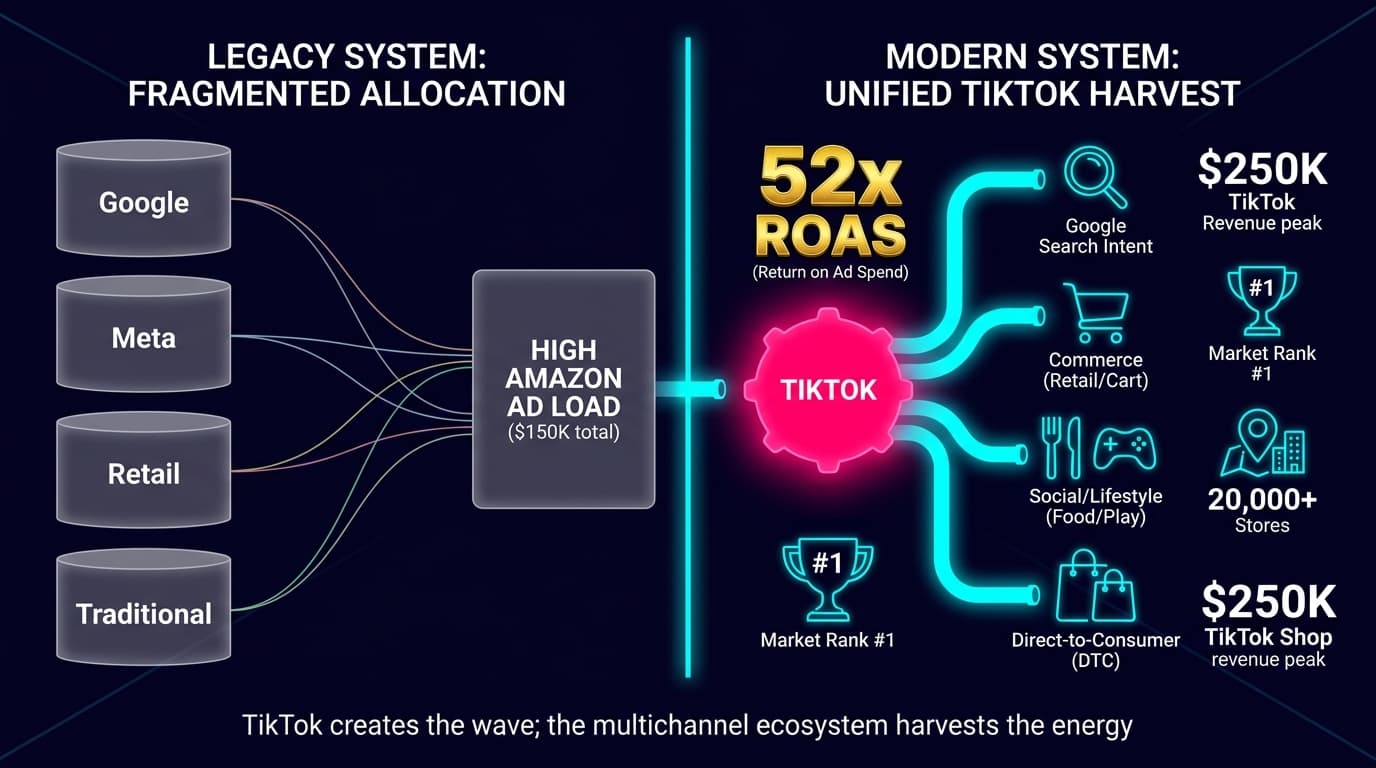
Neurogum multichannel revenue without Amazon ads
Before this shift, Neurogum ran separate ads on Amazon, bottom-of-funnel campaigns on TikTok, and treated each channel like its own business.
After the shift, they concentrated spend on TikTok awareness and Google PMax for intent capture. Every other channel grew organically.
How to Spend More on Less and Grow Everything
Kent shared the actual breakdown on the podcast.
TikTok takes the primary budget. 80% goes to top-of-funnel awareness, 20% to bottom-of-funnel. Google PMax gets a large and growing share to capture the search demand TikTok generates.
Facebook sits at 20 to 30% of digital marketing spend. Kent treats it as hygiene rather than a growth driver. Amazon gets zero ad spend.
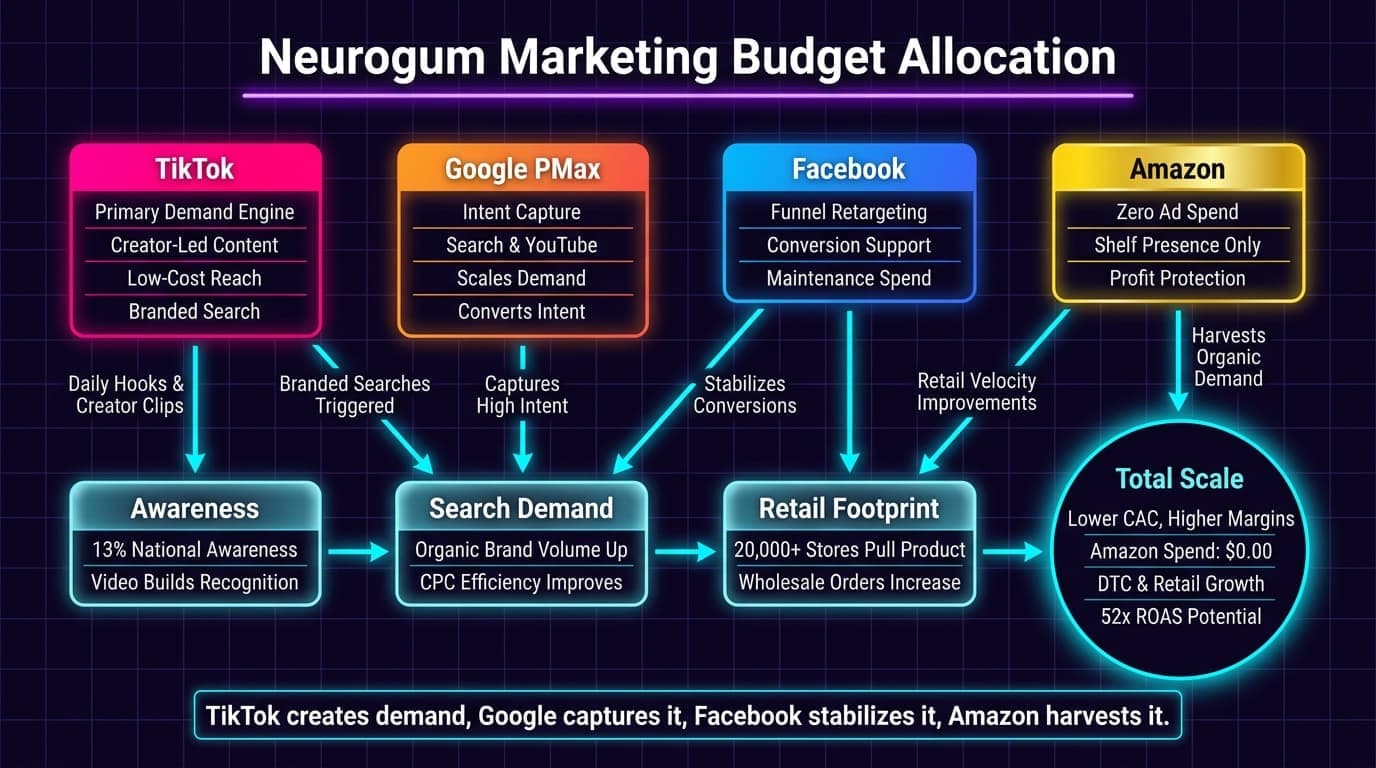
Neurogum marketing budget allocation breakdown
Pushing budget into top-of-funnel TikTok reduces TikTok-specific ROAS. That number goes down. But Neurogum stopped caring about channel ROAS. They look at total revenue, total profitability, and total awareness.
When they made this shift, all 3 went up. Revenue climbed. Profitability improved. Brand awareness went from near-zero to 13% nationally.
The counterintuitive part: spending more on one channel while cutting spend everywhere else produced better results than spreading the budget across all of them.
It's the same logic as picking one skill on your resume and going deep. The intern who's OK at design, OK at code, OK at copywriting gets passed over. The one who's elite at design gets hired, and then the company teaches them everything else.
Most brands ask how do we optimize each channel? Neurogum asks a different question: which single channel creates demand that lifts everything else?
It's the same logic behind a good gym routine. You don't need 15 exercises. You need 3 compound lifts that work everything at once. The deadlift doesn't just hit your back. It hits your legs, your grip, your core. One movement, total coverage.
For them, it's TikTok. For another brand, it might be something entirely different. The principle stays the same. Find your demand engine, feed it aggressively, and let the spillover do the work.
Top Tweets of the day
1/
If you are in the advertising rabbit hole, you can easily spot an ad from a mile away, but most normies don't know that.
Only the innies know. Outies don't.
2/
One of the best things to do is calling your shot and then going viral. And then you can use that as a marketing asset.
If it doesn't work, nobody will know. If it does work, you just got a proof.
3/
Money & distribution are 2 things you need to get as much attention on anything you launch.
Its a cycle:
Money can get you distribution via organic, email, seo, or paid ads.
Distribution can get you money by making an offer.
One of the reasons startups raise $10M+ funding is because they want as much distribution as they can NOW by making 100s of people work on their thing to make even more money. And the only thing it costs them is <10% equity on a good deal.
Rabbit Holes
What’d ya think of today’s newsletter? Hit ‘reply’ and let me know.
Do me a favor and share it in your company's Slack #marketing channel.
First time? Subscribe.
Follow me on X.
More Startup Spells 🪄
SlapMac Viral Marketing: How a Prank App Made $5,000 in One Week (LINK)
How Basecamp's PR Strategy Generates Millions in Free Press (LINK)
How Alex Hormozi Uses the Kevin Hart Meme to Revive Dead Leads (LINK)
Raycast Wrapped's "Copy as Image" Strategy: Engineering Virality (LINK)
Wave AI's "Day-Zero Payback" Meta Ads Machine (LINK)
Reply