- Startup Spells 🪄
- Posts
- How Ahrefs SEO Glossary Built an SEO Machine With One Boring Page
How Ahrefs SEO Glossary Built an SEO Machine With One Boring Page
PLUS: What are some hacks of real founders who did things that don't scale?

Startup Spells 🪄
January 17, 2026
Zendesk Relate 2026: Denver, May 18-20

Zendesk Relate Denver 2026
The world of CX leadership is changing rapidly! Drive meaningful change for yourself and your team. Explore new potential partners and tech with peers. Dive in with hands-on product workshops and share practical experiences. Learn. Grow. Lead. Innovate.
Join us at Zendesk Relate in Denver to learn how top brands like Canva, ASOS, Levi's, and Supercell are transforming service.
This is an advertisement.
Ahrefs SEO Glossary functions as an SEO machine built on a single strategy: becoming the definitive resource for an entire industry of SEO.
It captures thousands of high-intent visitors every month through this simple database of definitions. Google prioritizes this resource because 270+ interconnected pages create a knowledge graph that demonstrates authoritative expertise.
Most startups chase the dopamine hit of a successful launch. Ahrefs chose a different path. It built a content moat that grows stronger every day as it ages like a fine wine.
On Ahrefs SEO glossary, you'll find 270+ pages explaining SEO terms, from 10x content to YMYL pages.

Ahrefs SEO Glossary Homepage: Main index page showing all SEO terms from 10x content to YMYL pages
The Anatomy of a Content-Led Growth Engine
The Ahrefs glossary is not a simple dictionary. It is a structured library starting at numbered entries and running through every letter from A-Z.
Each term receives a dedicated page designed to answer a specific user query.
Ahrefs treats every entry as a standalone asset. When a user clicks on 10x content, they do not find a one-sentence blurb. They find a full article complete with headings and detailed strategy.
The 10x content entry contains the title as well as all the headings and a detailed article.

Ahrefs Glossary 10x Content Article: Detailed glossary entry showing full article structure with internal linking
Each entry has headers, detailed explanations, and links to internal and external resources. At the bottom, you'll find more internal links and conversion CTAs.
This structure forces Google to recognize the site as a topical authority. It signals that the company understands the entire ecosystem of its industry, not just the highlights.
Turning Dictionary Definitions into Topical Authority
Ahrefs understands that thin content is a liability. Its glossary pages often exceed 1,000 words. The page for 10x content credits Rand Fishkin for coining the term in 2015 during a Whiteboard Friday episode.
By providing historical context and actionable advice, the company transforms a simple definition into a high-value resource. This depth encourages other sites to link back to the glossary as a primary source.
Each glossary page follows the same structure:
H1 title matching the search term
Multiple H2s breaking down the concept
600-1000 words of detailed content
Internal links to related terms
External links to authoritative sources
CTAs driving product signups
How Internal Linking Creates a Content Spiderweb
Authority is not just about writing. It is about connecting. Every glossary entry at Ahrefs is a node in a massive internal network.
At the bottom of each article, the company places links to related terms and core product pages. This keeps users on the site longer. It also passes link equity from high-ranking pages to newer, lower-traffic entries.
Ahrefs Glossary Internal Linking Footer: Bottom section of glossary page showing related terms and conversion CTAs
This strategy turns the glossary into a funnel. A user arrives to learn a definition and leaves by starting a trial of the software.
The main glossary page links to every entry. Individual entries link to related terms. This creates a web of internal links that distributes link juice across the entire glossary. When one page ranks well, it boosts the others.
Why Google Rewards Entity-Based Expertise
Google has moved beyond simple keyword matching. It now uses entity-based SEO to understand relationships between real-world objects.
When you search for a specific SEO term, Google looks for a domain that demonstrates a relationship with that entity. Ahrefs dominates these results because its 200+ pages create a map of the entire SEO industry.
Google rewards them with free traffic. When you search for entity-based SEO, Ahrefs owns the top spot.
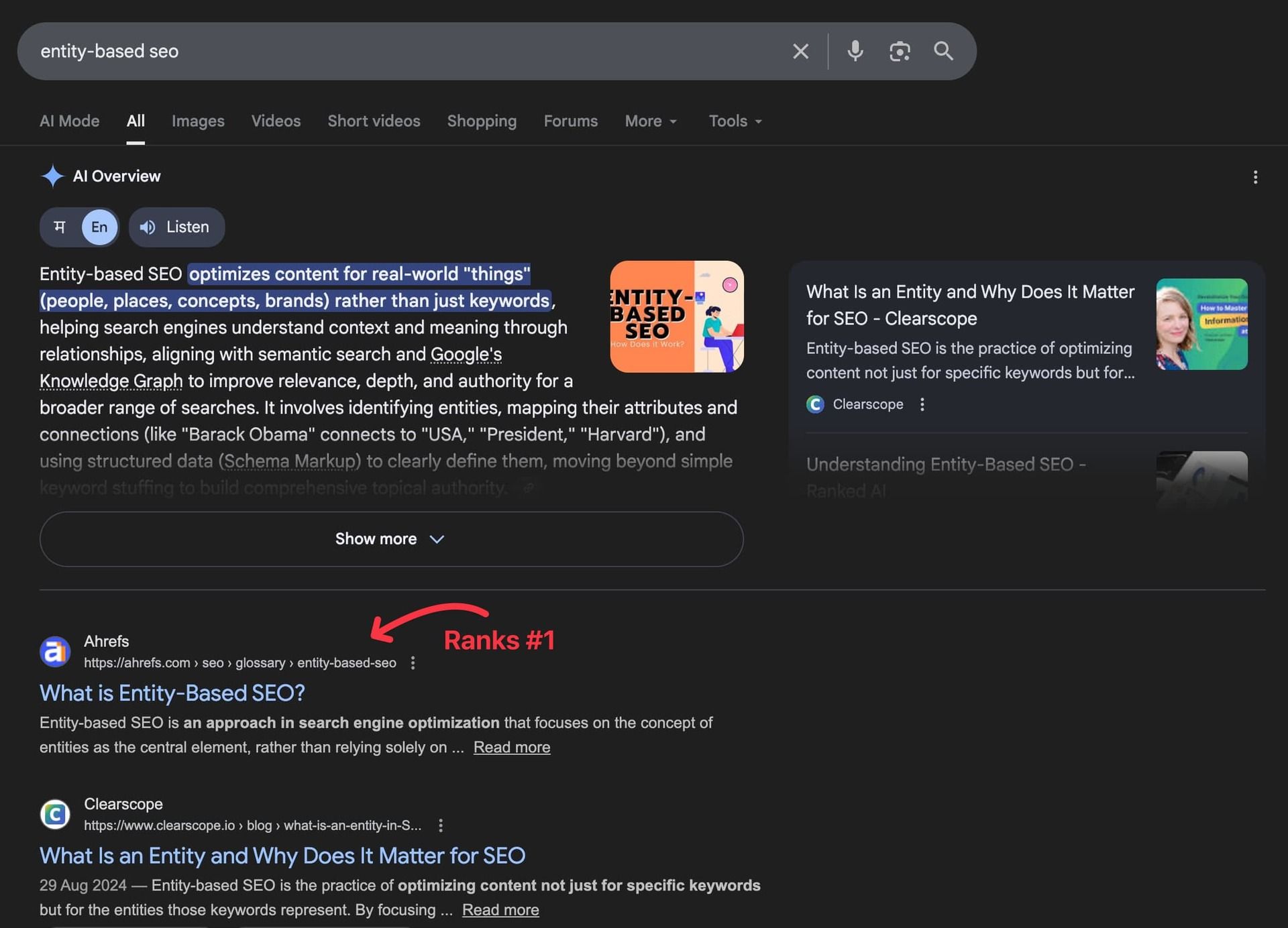
Ahrefs Ranking Entity Based SEO: Google search results showing Ahrefs SEO glossary ranked #1 for entity-based SEO
When the algorithm sees hundreds of well-linked pages, it assigns the domain a higher trust score. This makes it easier for every future page the company publishes to rank on page one.
The sitemap reveals the scale of this strategy: 270+ dedicated pages, each optimized for a specific keyword.
Here's a sample of the sitemap structure:
<url>
<loc>https://ahrefs.com/seo/glossary</loc>
</url>
<url>
<loc>https://ahrefs.com/seo/glossary/10x-content</loc>
</url>
<url>
<loc>https://ahrefs.com/seo/glossary/301-redirect</loc>
</url>
<url>
<loc>https://ahrefs.com/seo/glossary/entity-based-seo</loc>
</url>
270 URLs. Each targeting a specific term. Each with 600-1000 words of content. Each building authority for the domain. The sitemap itself helps Google discover and index all pages efficiently.
The Math Behind Evergreen Traffic ROI
Ahrefs manages roughly 200 glossary pages. The math is simple. If each page attracts 50 monthly visitors, that's 10,000 highly targeted visitors per month.
These visitors are actively seeking knowledge in your niche. Unlike a Facebook ad, these pages do not stop working when you stop spending. They age like wine. They compound in value while lowering your overall customer acquisition cost (CAC).
270 pages targeting long-tail keywords equals 270 opportunities to rank. Compare this to blogging about news or trends. Those posts have a half-life of weeks. Glossary terms are evergreen.
Each glossary page costs nothing to maintain once written. The content is evergreen—SEO terminology doesn't change often. Traffic compounds over time as more pages rank.
Ahrefs' glossary does something most marketing doesn't: it builds trust before asking for a sale.
When you search for a confusing SEO term and land on Ahrefs, you get a clear explanation. No sales pitch. No hidden agenda. Just value.
This creates positive brand association. The next time you need an SEO tool, you remember Ahrefs as the company that helped you understand the concepts.
The CTAs at the bottom of each page capture this trust. After reading a helpful explanation, you're more likely to try the tool.
Building Your Own Glossary in 5 Steps
You don't need Ahrefs' resources to make your own glossary. AI makes this accessible to any business.
Step 1: Identify your industry's vocabulary
What terms do customers search for? What jargon needs explaining? What concepts do you explain repeatedly in sales calls?
Use a tool like Manus AI to crawl competitor sites and extract a list of 100+ industry terms. Manus AI gives a ton of terrific data in a human-readable format if you want to nail down your niche-related terms and topics. You'll get a prioritized list based on search volume and relevance.
Step 2: Create a content structure
Follow Ahrefs' template. Avoid the dictionary trap. Write articles that explain the how and why of each term.
H1: The exact search term
H2: Definition or overview
H2: Why it matters
H2: How to use it
H2: Common mistakes
Internal links to related terms
External citations where appropriate
Sometimes you can link to your existing blog posts if the term deserves more comprehensive coverage. Ahrefs did it for the term Backlinks.
Step 3: Build the linking architecture
Your main glossary page should link to every term. Wield internal links strategically. Connect every term to 3-5 other entries in your glossary. Link your best entries to your product landing pages.
At the bottom, add a You might also like section with more links. This creates an internal link network that boosts all pages.
Step 4: Optimize for search
Each page should target one primary keyword. Include the term in the H1, URL slug, first paragraph, and naturally throughout the content.
Use tools like Ahrefs or SEMrush to find related keywords. Include those as H2s or H3s within the content.
Submit your sitemap to ensure Google Search Console sees your new library immediately by submitting a dedicated XML sitemap.
Step 5: Add conversion elements
Place CTAs at the bottom of each page. They should be relevant to the term—e.g., after explaining keyword research, link to your keyword research tool like Ahrefs does.
Building a glossary is slow work. It lacks the excitement of a viral video or a celebrity partnership. Most startups abandon the project after 5 entries because the traffic does not spike instantly.
Glossary page is a long-term investment that requires patience and methodical building. But it's a slow burn that pays off over time.
The Real Lesson
Ahrefs through its SEO Glossary built a knowledge graph that signals expertise to Google and value to users simultaneously.
Ahrefs chased content comprehensiveness within one domain: SEO.
Comprehensiveness creates authority. When you become the dictionary for your industry, you get backlinks easily which drive traffic to your site and increase your visibility in search results.
Top Tweets of the day
1/
Amazing way to target tier-1 demographic by asking for past 10 videos analytics.
2/
Lots of gold in replies here.
3/
Extremely well-written breakdown of social media algorithms.
TikTok and X follow this algorithm. Meanwhile, Instagram is more follower based than interest based.
Rabbit Holes
What’d ya think of today’s newsletter? Hit ‘reply’ and let me know.
Do me a favor and share it in your company's Slack #marketing channel.
First time? Subscribe.
Follow me on X.
More Startup Spells 🪄
How Claude Targets Developers With Google Ads Using Smart Bidding (LINK)
Influencer Collaboration Strategy That Built Unsplash Collections (LINK)
How SEO Roast turns free tools into $5,250 audits (LINK)
Kalshi influencer marketing: $1,000/month for 12 quote-tweets on X (LINK)
Pizza Hut guerrilla marketing: PR on a $500 budget (LINK)
Reply